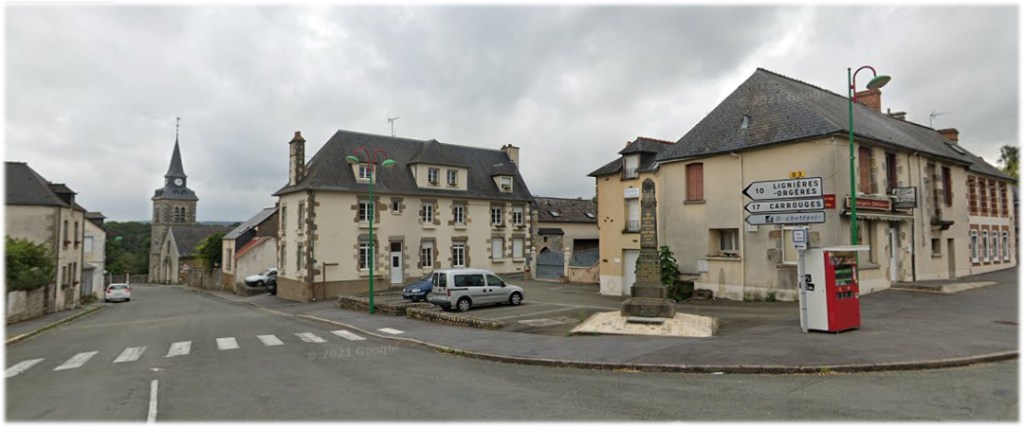
Couptrain is a small village in France situated in Lower Normandy on the border between the departments of Orne and Mayenne. It lies between Domfront and Alencon on the D176.
The village and the surrounding area found itself gaining some interest for a short while during the liberation of France. The village was liberated by American forces on the 13th August 1944.
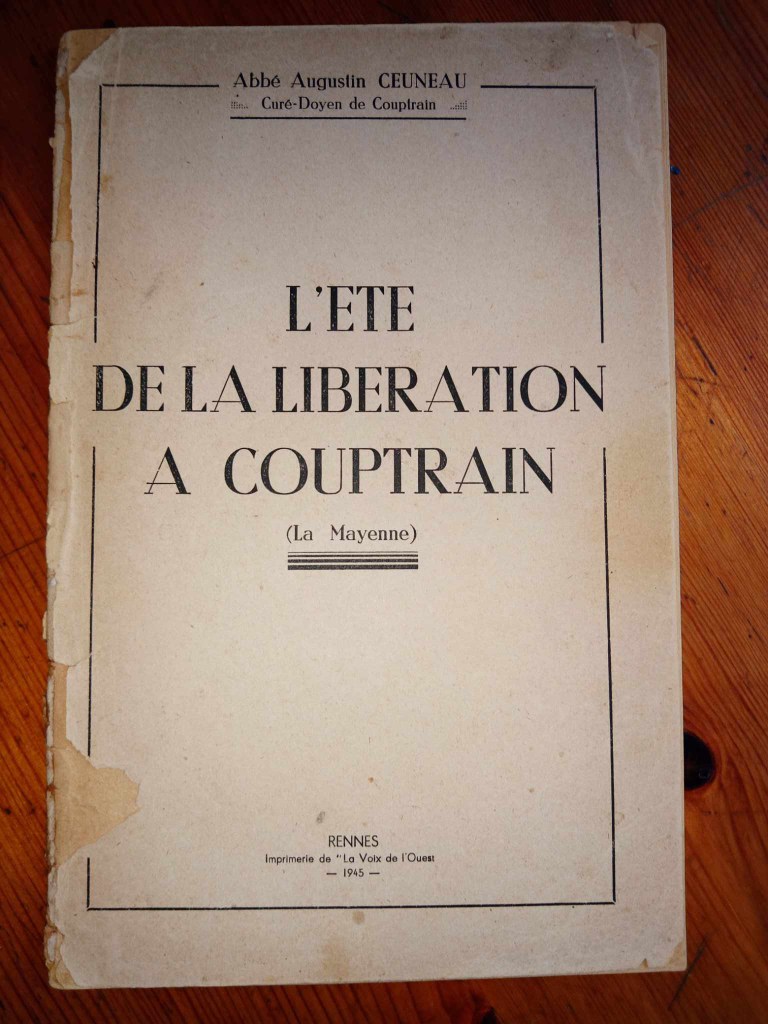
This account is, in the main, taken from a booklet written in 1944 by “Abbe Augustin Ceuneau” who was at the time “The Priest-Dean of Couptrain” It covers the period from the night of the 12th of August 1944, through to the 14th August 1944 and it is the best historical document I have found that covers “The Liberation of Couptrain”
BEFORE THE BATTLE
Morning of Sunday August the 13th the night was eventful: Artillery could be heard all through the night toward DOMFRONT, the sound of rockets and bombs getting louder as the enemy retreated.
At 5am forty Germans with machine guns and ammunition arrived near the Couptrain Memorial, their Officer (a Lieutenant) motivates them for some fifteen minutes. The officer will later in the evening be killed in Couptrain.
At the same time Madam TALLOIS, opened her Bakery, which is situated next to the memorial. Even though she could not understand what she heard but she could see the Officer’s gestures, his movements and the word “KAPUT” being repeated many times showed the soldiers are being invited to fight to the death.
The 8am mass was celebrated quietly; the weather forecast is very good promising a clear sunny day.
At 9am many aircraft pass above and start strafing and bombing Saint CALAIS, La PALLU, La MOTTE and also MONNAYE woods, the bombing is lighting some fires producing large and heavy smoke columns. It is all making an infernal noise that has prevented people from going outside.
BATTLE STATIONS
Germans are posted at corners of roads, especially at La Madeleine, near La Croix de La Chevalerie, at the Pont Rouge and on the Village Place, behind the Memorial where they piled up their ammunition, containing hand grenades, Bullets and ammunition ‘belts for Machines Guns, Rockets, mines, etc… There are maybe 200 boxes. As they saw those preparations, lots of people in the centre of the town retired to the countryside, so as when the Church bell rang for the Mass, at 10.45am, there is nobody in the streets. Only 20 persons are at the Short Mass after the Saint Sacrament benediction, all of them quit quickly in the Hamlet, there is a dull silence amongst the villagers as the sound of aircraft and Artillery rumbled overhead and around. There’s also a feeling of electricity in the air, I don’t know which kind, but it feels like bad electricity.
AMERICANS ARRIVE
During this time, American ‘tanks are on the road south of Couptrain, they had stopped at 11:30am for lunch in the fields around the Saint AIGNAN Road and have now restarted again, preceded by Infantry Pathfinders. It was maybe 1pm when a few of them passed over the railway and head on towards Couptrain.
Suddenly the Germans who have been posted at the crossroad and in the factory of La Madeleine where they have put their anti-tank guns (Howitzers) the battery opened fire on the lead tank and severely damaged it, killing the driver and wounding others. 5 Pathfinders were taken prisoner, they were brought to the LEMOINE house near the Church where they remained until their comrades arrived later.
As he saw that, the Officer in Command of the American detachment ordered a retreat back across the railway toward the Station. At the same time he orders up air support by radio, to destroy the enemy strong point.
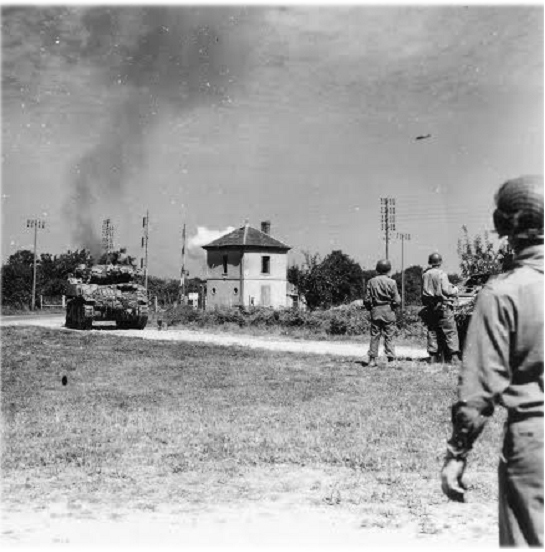
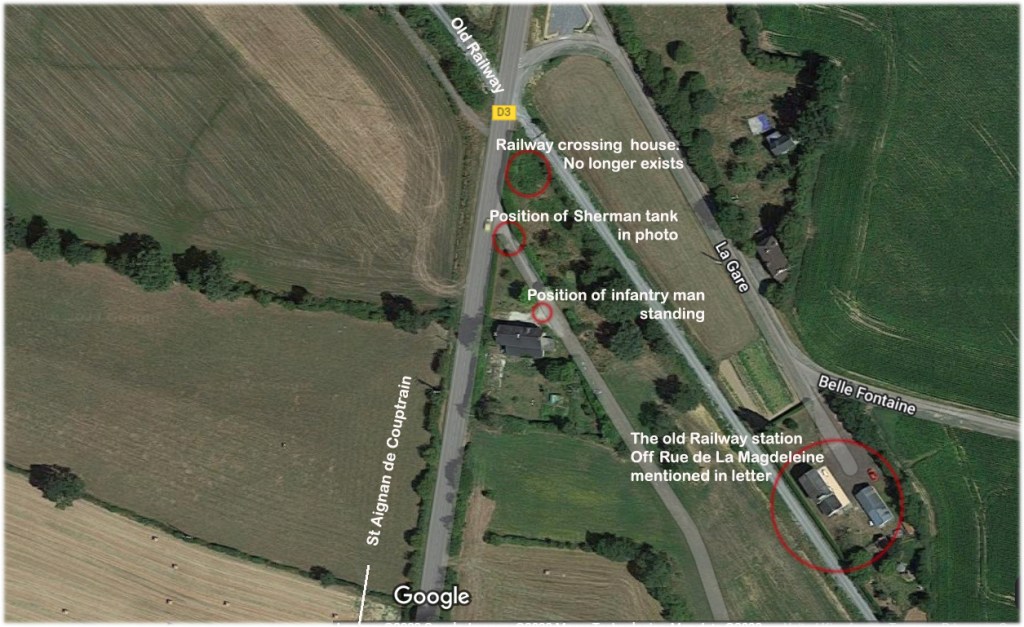
The Air Force responded to the call, at 1.30pm with many double fuselage aircraft, these liberating aircraft are well known to us (P38 Lightnings), they appear suddenly in the splendid sky of that nice day. They turn a little and beat up the area, whistling over the Village with their deadly and tense noise made by their two Allison engines. They warn us one more time, then, suddenly they open fire on buildings and fields all around the crossroads and in the factory of La Madeleine.
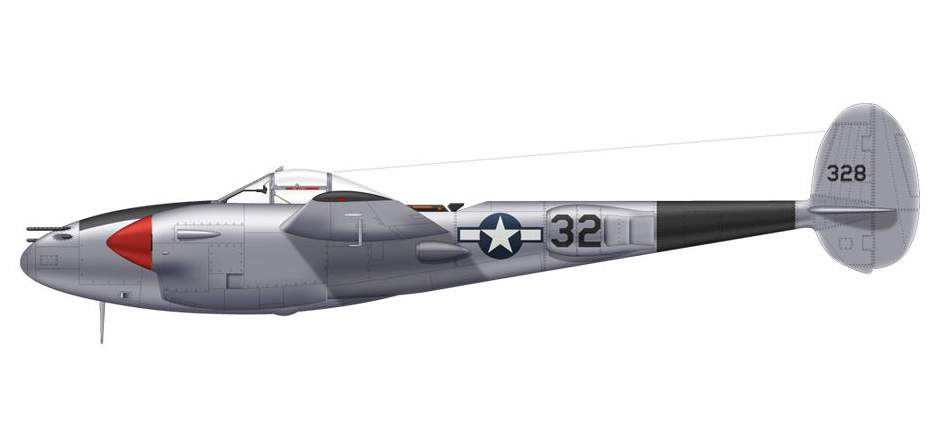
German soldiers leave their weapons on the site and flee, taking with them two comrades who are seriously wounded. They took care of them only in a summary fashion because they haven’t anything with them. They are kept at the LEMOINE house until in the evening the Americans take them to a Field Hospital.
The result of the strafing was immediate within the Village, nobody knows what the target of the aerial attack is, a few thought it was about a Gas truck, because of the black thick smoke!
Quickly we found out it was Mr. Louis FRESNAIS-DESBOIS factory who had been the target and burning like that with all those fats, skins, wool, bones, etc… All these matters were an ideal source for a fire! Nothing is left of the 40 meter building, melted copper boilers, bent force transmission system are deformed by the fire.
Mr. LOUIS FRESNAIS had earlier (in July) been involved with an Escape and Evasion affair of three American Paratroopers who had jumped from a German prison vehicle just outside of Couptrain. That story is told within this website under the title of:
‘The courage of Louis Fresnais and Marie Moulay’
American tanks then open fire on the factory and the immediate neighborhood, they seriously damage M. GESLAND’s workshop and the house that the CHAPELIERE family have only just left maybe half an hour before the attack. Shells are whistling and explode sinisterly above the Village as the shrapnel falls down everywhere, thankfully without any damage for the population. As the danger of approaching conflict is imminent more citizens and refugees flee to the countryside and especially in the MARCOUET path. There is now few people in the village.
About 3pm, there is a lull and a quiet moment appears. The Priest decides to ring the Church bell for a brief Mass as there is a possibility to sanctify the Sunday and as more prayers seem to be necessary during the present conjunctions. Only twelve people are present and is held in an office as many houses are empty. People say that the villagers of COUPTRAIN who were in the country around and about the village thought it was a good foreboding. However, after our duty was done, each of us went back to our homes waiting anxiously the events to come.
PATHFINDERS PENETRATE INTO COUPTRAIN
During this time the American pathfinders moved forward to COUPTRAIN. They do it cautiously and methodically, sending patrols out to explore the houses and the areas in the vicinity around us.
Tanks travel across the Belle Fontaine prairies. Mr REBOUX and Mr Eadourd LECHAT are looking for any resistance and attacks by Germans but the soldiers mainly retreat to Le Pont Rouge on Pré en Pail Road, but not all of them. There will still be casualties on both sides.
The patrol that have penetrated into M. Jacques FRESNAIS property see four Germans getting out of the front yard with their Machine Gun and take position in the GOUFFRIER path. In one second, two of them are killed and the two others run away. In the Canal Prairie a German is mortally wounded as in La Chevalerie Orchard an American was killed and another one seriously wounded by Germans who took position with their machine gun near the Croix de la Chevalerie.
It was 4.30pm and I was in front of Mr. PICHEREAU’s workshop with his family and a few other people when three American soldiers (that we took first for German as it was a usual thing for us to see them pass) coming from the Presbytery path and going toward the centre of town along the walls. They check closely all the houses, doors, windows and corners. We wait quietly as we don’t want to expose ourselves in the street, knowing as, in Mr. LEMOINE’s house, Germans are posted to watch, them too, on the LIGNIERES Road!
TANKS ARRIVING AT THE MEMORIAL CROSSROAD
At exactly 5.15pm, the first American tank arrives at the crossroad nearby the Memorial. The tank stopped and let the Pathfinders slowly walk forward on each side of the road. Immediately gunfire started from the German post situated on the Pré en Pail Road and the heavy machine gunfire scarred the Hotel BONDY (now Le Famous Knight) located just in the line of fire. Bullets were whistling around, but there is nobody in the street! As always the tanks continue to move forward, quietly squeaking and rattling as they progress. What a powerful modern new weapon, we are amazed to see these huge machines move so easily, they will continue to pass for five hours, until 10.30pm. We notice that the drivers, Artillery Servants and Pathfinders are all perfectly equipped with good shoes!…
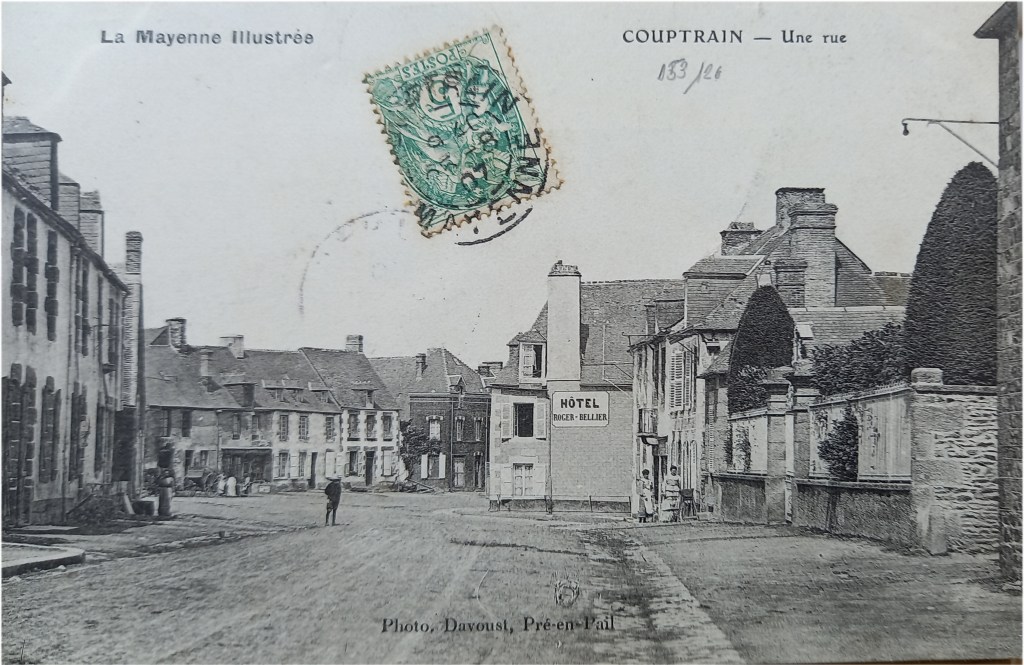
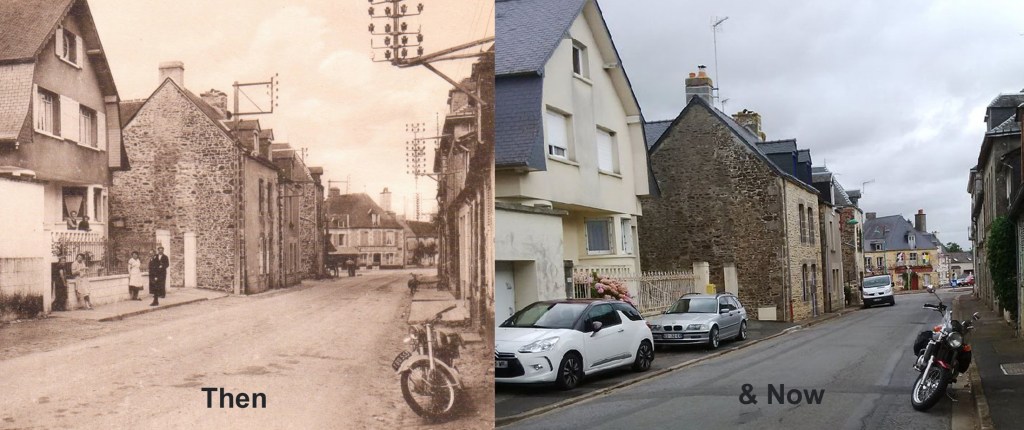
Hotel Bondy – In this card (1905) it has the name Robert Hellier, now a days called Le Famous Knight.
The tank would be appearing from the left in this photo and crossing the road straight past the hotel.
COUPTRAIN Citizens who saw the Armoured convoy crossing the Village were surprised to see on the top of one, (as a Guide) a young Resistance Man, a native of COUPTRAIN. He is Jacques MARTINIERE, a son of the former School Headmaster, at the present time living in EVRON, we salute him and his compatriots. He is happy and proud of his duty, I can understand that, but unfortunately, during the RANES battle on August the 16th a shell broke his two legs, one of them was saved despite the terrible wound, but the second one was amputated! A hard price to pay, but for the glory that honoured this brave lad and his family.
At times the tanks would stop, they are all equipped with radio antennas, they would then restart again (as one) after the tanks and a radio car had sent and received some messages.
By precaution, the detachment Commander had called for aerial reconnaissance of the LIGNIERES and CARROUGES road and the immediate neighbourhood. So, at about 6.30pm and for the following hour, the “double tails” (P38 Lightnings) were strafing and bombing without respite around the Croix Guillaume where trucks were exploding and the woods burning. The Saint HURSIN village, which has the same named farm and Patricière are on fire, as are German trucks within the Monnaye forest to the Haudre plateau and to Joué du Bois. Large fires are shown up by the huge black smoke columns rising up into the sky.
The noise is indescribable both in the air as on the ground.
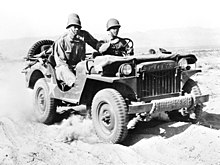
With tanks and trucks now coming through the village, along with curious little cars containing Officer’s and Soldiers, one type was named “Jeep”
At 10pm one of the German Soldiers badly injured at La Madeleine called for me, he is very bad, I gave him the Last Sacrament (rites) with the COUPTRAIN Gendarmerie Chief and an American Headmaster Doctor present as witnesses. After his death, He was immediately evacuated with his comrade prisoners to JAVRON.
LA CROIX-GAHIN AND DU FRESNE BATTLE
The armoured column slowly made their way towards LIGNIERES but was being watched by Germans on battle stations at Fresne with six 88mm anti-aircraft and anti-tank artillery guns and machines guns. One of the 88mm heavy guns is positioned directly on the La Pallu road, just a little bit before the Croix-Gahin crossroad waits for the Americans. The Villagers, despite their desire to do so, can’t warn the Americans in time.
The first tank was destroyed by a direct hit killing the driver and crew. The column stopped immediately, and many tanks crossed the fields and arrived from the back of the guns, but the Germans have now abandoned the area after destroying the bolts from the guns. The tanks then open fire against other guns which are then soon destroyed by Air support, killing several Germans and wounding others. They have also destroyed trucks and ammunition caches, sadly a few old FRENE village buildings are put on fire. The surviving Germans retreated to the Saint CALAIS Cave where few of them were arrested the next day, but a few others escaped.
The two Howitzers installed by the Germans in the morning of August the 13th in sight of COUPTRAIN and PRE EN PAIL, on the Haudre Plateau in Saint CALAIS could become a threat for the column or both Cities but that didn’t happen because of the air support in the morning, they had fired on them and then came back and finished the job in the evening they also set fire to other trucks, some materials and also fifteen requisitioned hay trailers!
The road was clear after the La Croix-Gahin crossroad, but the incident delayed the Americans, so they arrived at LIGNERES ORGERES in the twilight hours. But they decide not to try and come in and to stay at La Plingère. The Germans had put two 88mm howitzers near the Church and had also bombed the COUPTRAIN Road to forbid the village access and also the CARROUGES and ARGENTAN, JOUE DU BOIS and RANES to FALAISE roads. It was that last road to Falaise the incoming column from COUPTRAIN must follow.
The previous one to Ranes was left to the famous Général LECLERC (his real name is Count Philippe de Hautecloque) and his Division.
The same evening, I learned the beautiful 18th Century Castle of La Bermondière on Saint JULIEN DE TERROUX was put on fire by Germans before they left in order to destroy some of their materials inside. It was a vandalism act to add to the long list of similar acts they have done.
THE COUPTRAIN NIGHT BATTLE
In the night at 10.45pm, two Germans tanks located at Pont Rouge moved forward to the top of COUPTRAIN hill and stopped a little bit before the MIRSON Farm at the entry of the Village. From there they dominated and fired on the LIGNIERES Road. One shell landed down near the bridge over the Mayenne, striking an auto canon (similar to a machine gun, but firing shells instead of bullets) the auto canon started to burn so violently that the two drivers died carbonized. Other shells started fires in the bush over the path and L’Ile d’Amour.
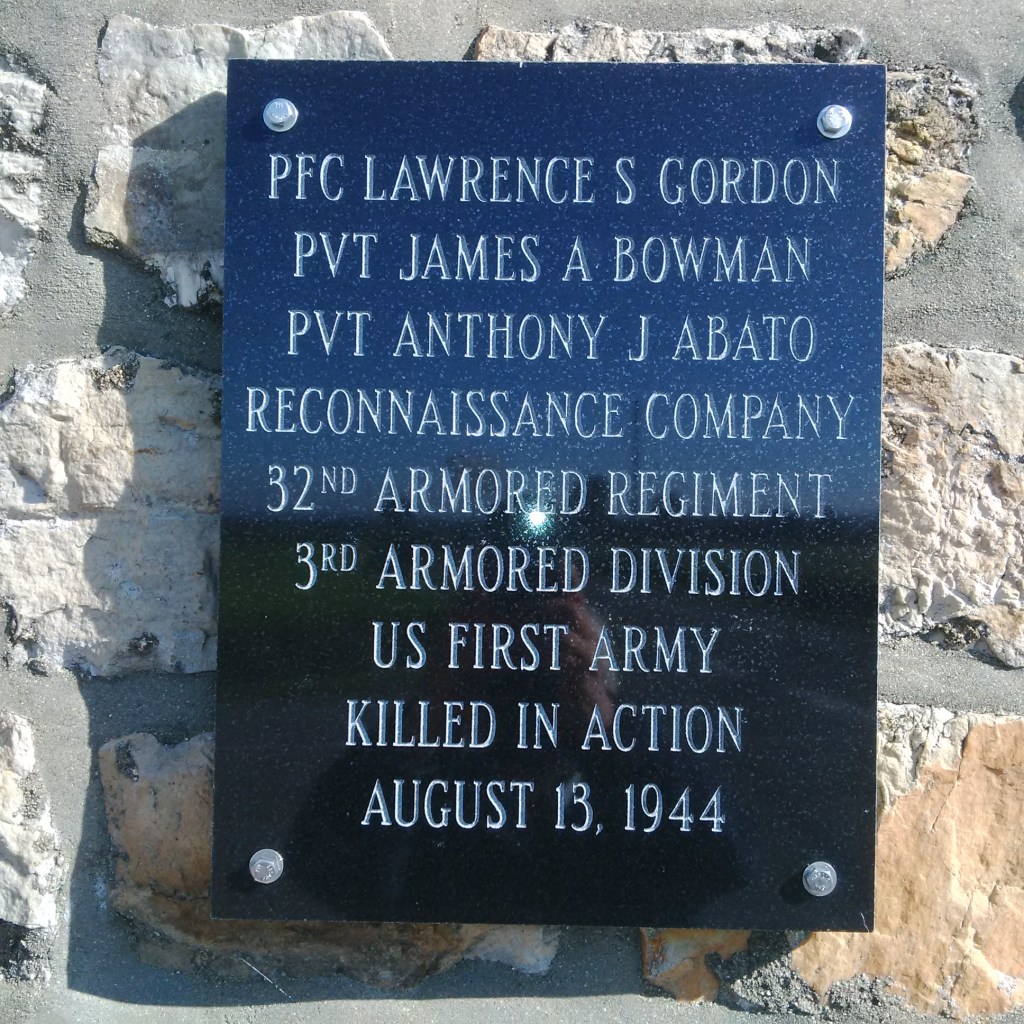
The night would be tragic even though we did not realise it. Already in the village we could hear some volleys. I withdrew to my presbytery not knowing what this meant; but soon soldiers passed below my windows; they were not speaking; they were Germans. Having left their tanks they were headed into the village by the path of Mr. Pichereau’s workshop; others took the main road to Pre-en-Pail, whilst another waited in ambush at the foot of the 1901 Jubilee Cross. This was a reconnaissance squad perhaps 40-men strong; they reached the centre of the village keeping a low profile. The commanding officer (the lieutenant mentioned before) was in front; as he reached the last step of the porch of Mr.Trubert’s house, he fell, taken by a machine-gun volley fired by an American soldier, who was himself then shot by his comrades who were positioned under the awning of the blacksmith’s shop of Deletang, and did not recognise him! This poor soldier fell just 20 metres from the German at the spot where the people of Couptrain subsequently dedicated the American memorial of the liberation of Couptrain, on 11th November 1944.
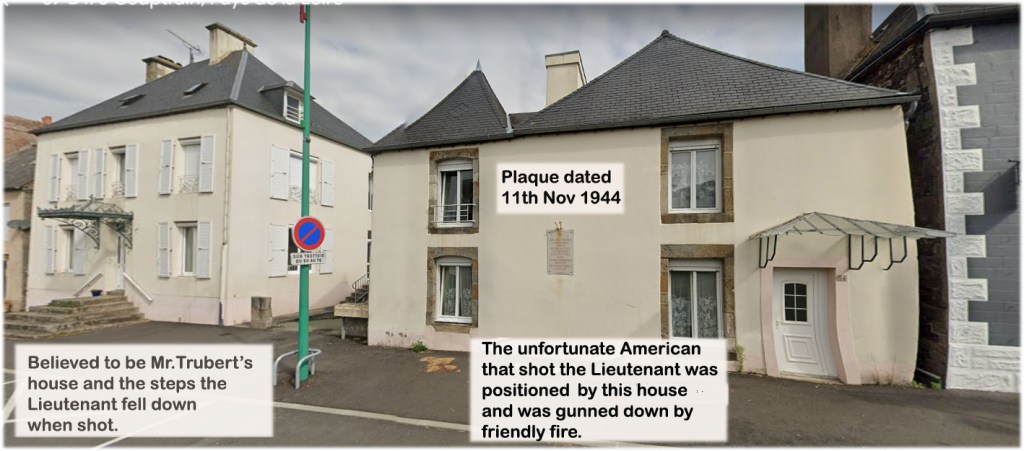
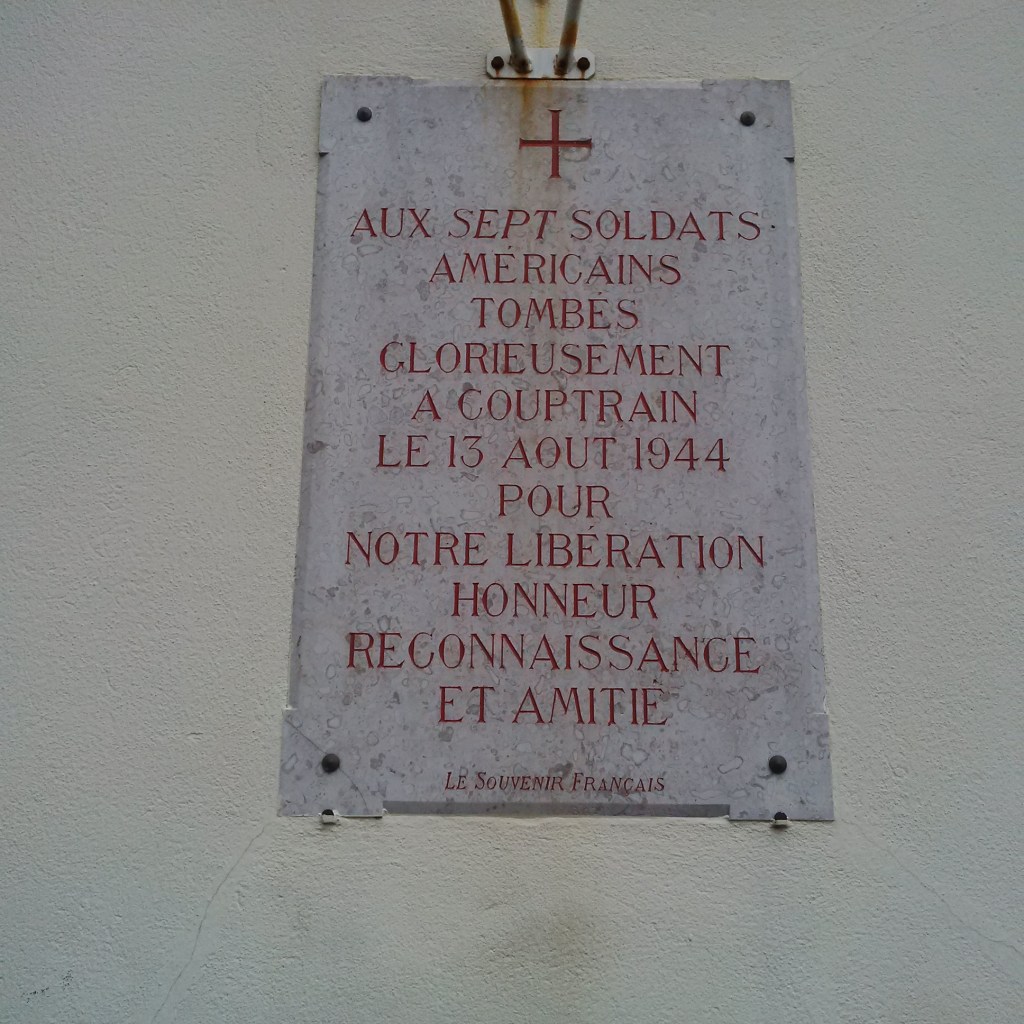
Two other Germans, an Officer and a Soldier were injured near the LEON Grocery, they died after their comrades tried to take care of them in the TOUCHARD house where they sheltered. They were moved by a Refugee M. PEUGNET via the Presbytery path to the MIRSON Farm. The Officer’s corpse will be carried away on a tank; the American soldier’s body will be moved the next day to the Military Cemetery, outside of COUPTRAIN, probably in the one created 6km from GORRON.
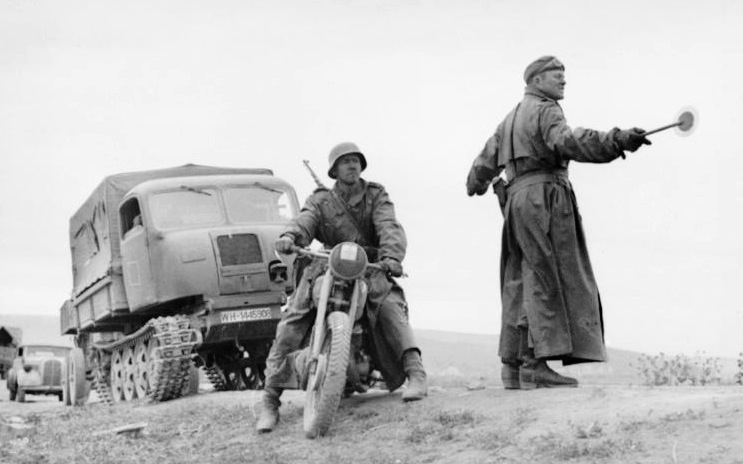
As best we can judge the goal of the manoeuvre was to allow the German’s to join the Column who had found shelter with some hundred Soldiers and five little caterpillars (Raupenschlepper Ost) held up in the nearby Saint CALAIS Cave.
Due to the impossibility to pass, the Germans retreated to NEUILLY LE VENDIN Road. As Mr. LIOT said, whilst he was hidden behind his shutters, with a very good view of the scene, about twenty soldiers have waited for about an hour at the Private School dead end entry and at about 2 AM, they joined together and crossed over gardens to the Presbytery path and NEUILLY Road, where, by via LA PALLU, they took off into the LA FERTE direction with other Soldiers that were found near the tanks.
Still within the river MAYENNE’s Valley, without interruption guns shots are heard.
It is impossible to get outside, on the Presbytery pavement too many bullets whistling around the area on each side of the Saint JULIEN stony path.
Two other Germans, an officer and a soldier, were wounded near the Leon grocers shop and subsequently died, despite being sheltered and cared for by their colleagues in the Touchard house; they would be carried by an escapee, M. Peugnet, who took the path by the presbytery as far as the Mirson farm; the body of the officer was taken away on a tank, that of the soldier, together with the four others already killed, were taken to be buried in a cemetery outside Couptrain, probably in the one which had been created about 6 kilometres from Gorron.
In so far as one can judge this maneuver, was to allow the Germans to rejoin Colonel Pillmann, (German commander) who was positioned with about 100 soldiers near the Grotte de St Calais.
Finding it impossible to pass, the Germans fell back on the road towards Neuilly-le-Vendin. According to M. Liot, who was able to witness this reconnaissance mission from behind his shutters, 20 men waited for about an hour at the entrance to the free school, and at about 2.00am crossed the gardes to reach the path of the presbytery an the road to Neuilly, from where by La Pallu, they headed towards La Ferte-Mace with other soldiers who had rallied to the tanks.
During this whole tragic episode, gunshots sounded continuously from the valley of the Mayenne. It was impossible to go out onto the terrace of the presbytery since bullets were whistling through the ash trees which lined the rocky path of St-Julien, doubtless the Germans were defending their retreat to the North. I suppose that was so, even though shots could be heard in the high valley towards the Grotte de St-Calais, where certain enemy units had retreated. Nevertheless, the war is very close to us, and surrounds us on all sides.
In the distance the forest burns, eerily illuminating the sky; the fire also burns the copses at le Taillis and the Ile d’Amour, whilst the guns rumble in violent waves from the North and from St Cyr-en-Pail and from the station at Couptrain, long-range American batteries which shake everything, incessantly bombard the forests of Monnaye and La Motte, the area around Lignieres and Saint-Samson. In this last commune, three farms were burned and 80 animals killed.
Within the vast undertaking which was the overall Liberation of France, the modest action in Couptrain must be seen in context. Nevertheless, it was sufficiently significant to come to the attention of the Allied Supreme Command by an official communique, and thus the conduct of the Liberation in their small corner of France, came to the attention of our fellow citizens living in Paris through the radio from London.
Monday, 14th August – Around 6.00am violent explosions were heard not far from St Calais; this was the Germans blowing up their five half-tracks, ammunition and mines before retreating from the route de la Grotte. This was the end of the fighting in the immediate area of Couptrain.
In the village, at 7.0am, everyone was talking about the tragic events of the previous night, and went to see the bodies of the soldiers who had fallen during this last enemy counter-attack. Already, flowers had been laid on the body of the American killed near the house of M. Felix Fresnais in the concrete of the façade of which were clearly visible the marks made by machine-gun bullets.
The people and the structures of the village had been saved. By the Grace of God!
Soon the American convoys of tanks, artillery, and equipment of all sorts drive down the road to Lignieres, hardly stopping throughout the day. They climb towards Falaise and Argentan, and the growling of the guns reminds us that the fight must be very hard.
At about 10.00am Neuilly is liberated; Saint-Calais at 13.00, after the last German units are taken prisoner or dispersed and La Pallu will welcome the Americans at 18.00.
Addendum.
The seven American soldiers names are still very much in dispute.


 ONLYVFR
Leave a reply to Chris Pamplin Cancel reply