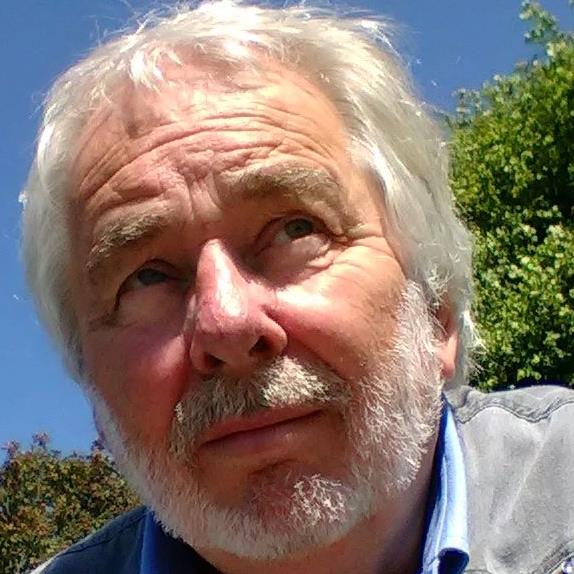
This account is about two courageous families from the area of Couptrain who sheltered three American parachutists. There are three pieces to the story.
The first: is an extract taken from a letter written by James Irvin to Jean Fresnais. (Louis’s son)
The second: Is taken from an article in the Norwood News North Carolina, USA dated 1990.
The third: The subsequent official records that cover the escape of all three after their help from the Fresnais and Moulay families.
James Irvin is one of the parachutists from the 82nd Airborne, a part of the 505th Parachute Infantry Regiment that took part on D-Day.
Monsieur, Louis Frenais of Couptrain.
In 2023 Pierrick Meron and I visited Jean Fresnais in Bagnoles. Jean is the son of Louis and Madame Fresnais, Monsieur Louis Fresnais was an industrialist of Couptrain and the surrounding area.
Jean was four years old when the liberation and subsequent events took place. Our visit to see Jean was to obtain geographical information about the locations of named houses in Couptrain mentioned in the Curates booklet written during the liberation of the little village in August 1944, but we came away with more than that. This is the story about his parents and Madame Moulay’s bravery as a result of sheltering three officers from the 82nd Airborne.
Madame, Marie Moulay of Madre.
Madame Moulay had a farm near Madre in 1944 and Madame Moulay’s farm is where the three Airborne Officers hid overnight and were found in the morning. Louis Fresnais, who could speak some English became involved because he was able to communicate with them, he also regularly used one of Madame Moulays barns to conceal his vehicles overnight so the Germans could not find his business vans and requisition them.
82nd Airborne, a division of the 505th Parachute Regiment on D-Day.
The 82nd Airborne jumped into France about 6 hours before the beach landings took place. Their objective was to capture and hold the town of St Marie Eglise in Normandy.
The first element jumped at 0151, by 0312 all paratroopers had landed. However many of the Parachutists and gliders were scattered and many small groups and units took time to rejoin their companies throughout the day.
An extract from Jim Irvins letter written to Jean Fresnais in 1984.
I will never forget the sacrifices that your Father and Madame Fresnais made to shelter and provide safety for me and my comrades during our escape and evasion from the Germans. They indeed saved our lives and disregarded their own safety. I can never forget what they did and the danger they accepted to help us.
This next piece is taken from The Norwood News in North Carolina dated December 1990. This piece was written again by the late James Irvin of the 82nd Airborne. Company B, 505th Parachute Infantry.
You have probably never heard of the small village of Couptrain, in Normandy, France. Not many people have. Not even most soldiers that served in World War Two would remember.
I remember the town and the people, especially the family of Monsieur and Madame Louis Fresnais.
It was on the 28th June 1944.
We, the 82nd Airborne had jumped into France on D-Day minus 6 hours before troops landed on the beaches. Our objective was to capture and hold the village of St Mare Eglise in Normandy and keep the Germans from getting reinforcements to the beaches.
It was an overcast night and as we flew over the English Channel it seemed that the ships below were so thick that you could have walked across.
The wind was strong that night and the anti aircraft fire was so heavy that some planes did not find the proper drop zones. Such was the case with my company.
At that time I was company commander of B Company, 505th Parachute Infantry, part of the company was scattered and about 15 miles from our objective. We met strong resistance early in the morning and fought a series of small skirmishes whilst trying to get organized and reach our objective.
At about 4 o’clock in the afternoon I was hit in the head by a fragment from a mortar shell and was temporarily unconscious. We were surrounded by the Germans and our position had become untenable.
I was captured and taken to a hospital in Valognese, France. A small city in in the Normandy peninsular where I was treated for my wounds.
Then having left the hospital and being evacuated by the Germans on the morning of 28th June 1944, I escaped with two other officers. We were sleeping in a barn, and did not know where we were, or if the area was occupied. About 11 o’clock some French children playing in the barn awakened us.
They informed their parents and a very distinguished man about 6’2” came and listened to our conversation, along with other people of the village. There were women and children, but no young men around as they were either prisoners or working (forced work) under guard by the Germans.
This man was Louis Fresnais he took us to his home and hid us in his garage, gave us food and clothing and suggested we try to get into the Brittany peninsular. We stayed with the Fresnais until the 30th June. We did not know their name at the time as we had been instructed not to ask for security reasons.
I did not know their name, or the name of the town (Couptrain) until the war was over and I was contacted by the Army about their help of escaped Americans. We corresponded with them and kept in touch over the years.
The above correspondence was obtained from Jean Fresnais the son of Louis. Jean was the man we met in Bagnoles.
James Morris Irvin passed away December 4th 2009. His obituary was in the Charlotte Observer on December 5th 2009.
The three Airborne officers:
Lieutenant James M Irvin (company B)
Lieutenant Robert D Keeler (company HQ)
Lieutenant George E Hendrickson (Company I)
Lieutenants IRVIN and KEELER injured during the clash with the Germans, are transferred by truck to a hospital in Valognes. Lieutenant KEELER will stay there for 6 days, until June 12, while Lieutenant IRVIN will stay there for 10 days, until June 16. As soon as they recovered, the American prisoners were placed in a large camp at Bricquebec located west of Valognes, bringing together many American paratroopers taken prisoner in Normandy. In this prison camp, officers are separated from non-commissioned officers and enlisted men. Lieutenants IRVIN and KEELER then find among their brothers in arms, Lieutenant George E. HENDRICKSON. Before the advance of the VIIIth American Army Corps in the Cotentin, the management of American prisoners of war becomes problematic for the German forces. The result is a transfer of all US prisoners to a new camp located south of Saint-Lô, in the Tessy-sur-Vire sector which takes place from June 17th. For able-bodied men able to walk, the transfer takes place on foot and exclusively at night. For 5 nights, the American prisoners march in step towards their new place of captivity. O n has about 200 enlisted men and non-commissioned officers plus about 50 officers. The conditions of captivity seem conducive to escape attempts since there are several of them from the first days during which the paratroopers were taken prisoner. Indeed, Corporal SULLIVAN and Private SHEPPARD will try to escape on June 12 but will be caught later. Note the successful attempt on the night of June 11 to 12, sergeants HENDERSON (also from company B of the 505th Regiment ) and LAZENBY who managed to escape the Germans and remain hidden for 37 days!
The nocturnal escape.
Taken from official US military records.
Lieutenants HENDRICKSON, IRVIN and KEELER – as well as other GIs – are quartered in a POW camp south of Saint-Lô from where it is decided by the Germans, a new transfer on June 27th. This trip will be accomplished by bus and at night in order to avoid the allied aviation which has control of the sky. The next stage of this transfer does not appear well defined according to the reports of this or that prisoner: some evoking the city of Alençon, others that of Paris. Still, during this period, a good number of Allied prisoners of war, wounded and able-bodied, were sent to the city of Rennes, either to the girls’ college transformed into a military hospital located rue Jean Macé, or to the Marne camp. located on the outskirts of Rennes in the Courrouze sector.
During the night of June 27 to 28, HENDRICKSON, IRVIN and KEELER boarded a German bus with about twenty other American officers who were prisoners. The 3 lieutenants placed themselves in the back of the bus, and IRVIN sat down next to the back door on which he had noted the presence of a key, undoubtedly forgotten by the jailers. The bus was guarded and flanked by 3 armed German soldiers who posted themselves at the front of the vehicle back to the road, so as to keep an eye on the American prisoners. It seems that the 3 lieutenants had demonstrated to their compatriots the will to take control of the bus by neutralizing the 3 armed German soldiers as well as the driver in order to organize a mass escape. However, the highest ranks among the American prisoners were not inclined to take action, surely deeming this attempt too risky. However, the 3 paratroopers were not demoralized. Around midnight, while the convoy made up of several motorized vehicles was heading south with all lights off, IRVIN showed his comrades HENDRICKSON and KEELER the key that had remained on the back door. Taking advantage of a steep road slowing the speed of the bus and covered by songs that the other US officers had started aloud, Lieutenants IRIVIN, HENDRICKSON and KEELER operated the rear door which opened halfway, waiting for an opportune moment to inattention of the German guards to jump on the bus. They met in a ditch in which they hid while the bus continued on its way without the German jailers noticing at once what had just taken place. The 3 fugitives waited patiently in the ditch for the passage of the entire convoy.78
Having managed to keep his escape kit which included a map and a compass, Lieutenant KEELER was able to determine the position of the group of fugitives. They were located nearby in Couptrain, in the department of Mayenne. They walked through the countryside for 3 hours before deciding on a break to sleep hidden in hedges.
On June 28, at daybreak, Lieutenant IRVIN went to ask for food at a farm located near where the escapees had slept. The farmer’s wife (Unknown) welcomed them warmly and cooked them a hearty breakfast. Satisfied, they resumed their journey for 3 km. Aware of the indiscretion that wearing paratrooper combat gear could cause, the small group agreed to quickly procure civilian clothing. So they stopped at a farm to beg for clothes more in keeping with the local environment. Luckily, the owner of the farm (Madame Moulay) contacted (Monsieur Frenais) who spoke English and managed to converse with their unexpected guests and told them that they were near the town of Lassay-les-Châteaux (Mayenne). Despite his apparent nervousness, (Monsieur Frenais) agreed with (Madame Moulay) to offer them room and board while he found them civilian clothes. The next day, June 29, civilian clothes were given to the 3 escapees and their paratrooper uniforms were burned as a precaution. The farmer suggested they go to Spain. But after consultation, the paratroopers thought it wiser to take the direction of Brittany and its coasts from where they could possibly find a boat to England. The farmer therefore told them the route to take to get to Brittany. Waiting for nightfall, the 3 lieutenants left on foot in a westerly direction.
The Breton Adventure:
On the paths that led them to the Armorican, Brittany Peninsula, the three paratrooper comrades HENDRICKSON, IRVIN and KEELER decided to separate so as not to excessively attract the curiosity of the natives and to reduce the risk of being captured. However, they vowed to meet in Brittany as soon as possible and once safe.
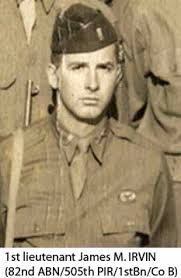
Saint-Thual: The hiding place of Lieutenant James M. IRVIN
After taking leave of his brothers in arms, Lieutenant IRVIN arrived alone in Saint-Ellier-du-Maine (Mayenne) where he went to the village church. He was welcomed by the local priest who spoke a little English and who provided him with a bicycle to take him to the Catholic boys’ school in Fougères (Ille-et-Vilaine). There, the American escapee met a young English teacher who prepared a route for him to follow along roads and towns towards the west of the department.
The following day, IRVIN followed the route established by the young professor and arrived at the town of Saint-Thual (Ille-et-Vilaine) located on the edge of the Côtes-du-Nord department. Taken in charge by the former mayor of the commune, Jean HOMO, then dismissed by Vichy, he found accommodation in IRVIN for one night. A popular mayor among his constituents, Jean HOMO had maintained friendly relations with certain residents of the town. Furthermore, Jean HOMO was a farmer and owned a farm at a place called Tremblais in the commune of Saint-Maden (Côtes-du-Nord), a commune neighboring Saint-Thual. He had established contacts with the local Resistance in Côtes-du-Nord since the place called La Sécherie, which is located near his farm, was a host area for resistance fighters.
The next day, the US paratrooper was placed with Célestin BRANDILLY’s family where he was hidden in the bread oven. Lieutenant IRVIN is told that another American is also staying with locals in Saint-Thual thanks to the help of Jean HOMO. This is 2nd lieutenant Blaine H. BARRITT, bomber operator on B-24 Liberator whose plane was shot down on June 12, 1944 above the town of Romillé (Ille-et-Vilaine). It is therefore very likely that Jean HOMO has contacts within the local Resistance allowing him to provide assistance to escapees. IRVIN and BARRITT will be accommodated with various residents in the territory of the commune of Saint-Thual so as not to attract too many attentions to their presence.
Sometimes, they will have to work during the day on the farms of Mrs. PINAULT and Ange LE BRUN, both residents of Saint-Thual. Having been informed of the presence of American escapees in neighboring towns, IRVIN and BARRITT decided one evening in July, passing through the field, to join a certain number of these compatriots at the farm of René GUILLOT located in the town of Plouasne (Côtes -North). The latter already hosts lieutenants Victor FLEISHMAN and Benjamin C. ISRIG whose B-24 Liberator bomber was also hit on June 12 above Romillé before crashing in the town of Bonnemain (Ille-et-Vilaine) . Joining them are Sergeants John L. BOROWSKI and Harry F. MEEKER who belonged to the same bomber as that of Lieutenant BARRITT. BOROWSKI and MEEKER who had been brought by an FTP resistance fighter, Fernand DELOURME, are hidden with Mr and Mrs CRESPEL living in the neighboring town of Tréfumel (Côtes-du-Nord) and who are in contact with the local Resistance. The 6 American escapees organize a consultation meeting among themselves in a room in René GUILLET’s house. Once the meeting is over, each pair will return to their respective accommodations. On August 2, 1944, the Saint-Thual sector was liberated by elements of General Grow’s 6th American Armored Division which rushed towards the objective of Brest. IRVIN and BARRITT then joined their compatriots and were debriefed by the division’s intelligence service on the hypothetical presence of German troops in the sector.
Lieutenant IRVIN and his compatriot, Lieutenant BARRITT, returned to England on August 9, 1944 for a more in-depth debriefing by the American intelligence services. Through this example of taking care of allied escapees, the leading role played by the Resistance shows both a form of organization in the transport of escapees and a form of prudence in the acquisition of places of refuge. accommodation with people not directly involved in armed struggle actions.
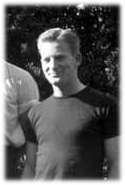
The journey of Lieutenant Robert D. KEELER: from the run to the fights for the liberation of Côtes-du-Nord.
Having left IRVIN and HENDRICKSON, Lieutenant KEELER continued alone in the direction of Fougères. Passing through the town without incident, he eventually reached the town of Saint-Rémy-du-Plain where he met the priest at the village presbytery. He advises him and helps him get in touch with the local Resistance in Antrain. There, KEELER is taken care of by a chief sergeant of the Resistance accompanied by 8 other patriots. The resistance then decided to hide Lieutenant KEELER in a wood located 250 m from the town of Antrain. In order to feed their “host”, the resistance carried out requisitions from the local population, a procedure which seemed to displease the American lieutenant. During this period in July 1944, resistance activity against the occupier increased in the surroundings of Antrain in connection with the events of the Broualan maquis. This activity is not without leading to a strengthening of identity checks, which pushes the resistance to transfer the American paratroop to a safer hiding place than the outskirts of a forest likely to be inspected by the German police services and /or collaborators to which is added the permanent risk of denunciation. Decision was made to send KEELER to the presbytery of Chapelle-aux-Filtzméens where the priest takes care of him. Suffering again from his previous injuries, the priest brings a doctor accompanied by 2 refugee women from Saint-Malo in order to alleviate the suffering of the American officer. One of his wives informs KEELER of the events that took place in the Broualan maquis and that his compatriot HENDRICKSON was arrested by the Germans and that he is potentially dead. After recovering his strength at Chapelle-aux-Filtzméens, the paratrooper was sent to the neighboring town of Pleugueneuc where he spent 2 days hidden in a hayloft. From there, a young woman from the Resistance takes Lieutenant KEELER to Mr. PINCHEDE residing at 24 rue Lord Kitchener in Dinan.
The next day, a meeting was arranged at 4:00 p.m., rue de la Chaux with Georges TILLOU, a member of the Dinan firefighters who could arrange to find accommodation for the American paratroop. Indeed, Mr TILLOU is already in charge of 2 other American escapees hidden in a chalet in Languédias (Côtes-du-Nord) which belongs to his friend André LEMOINE. The same evening, KEELER is invited to eat and sleep at Mr TILLOU’s house. The next day, KEELER is disguised as a fisherman by Georges TILLOU with all the necessary equipment and a bicycle is obtained for him thanks to a friend of the latter. Being a member of the Passive Defense, Mr TILLOU has an armband allowing him to facilitate passage through German controls. Georges TILLOU manages without damage to take the American escapee to his friend André LEMOINE in Languédias where the US paratroopers find 2 compatriots aviators: 1st lieutenant Franklyn E. HENDRICKSON P-51 Mustang fighter pilot whose plane crashed in Plesder (Ille-et-Vilaine) on April 26, 1944 as well as Flight Officer John W. GINDER, P-47 Thunderbolt pilot who crashed in Trévron (Côtes-du-Nord) on June 10, 1944. The 3 American escapees will be accommodated for approximately 2 weeks at the chalet of Mr LEMOINE receiving the regular visit of Georges TILLOU as well as that of the priest of Languédias, Father CORBEL, English-speaking and who provided, on several occasions during the war, assistance to escaped Allied airmen.
On August 2, 1944, while Georges TILLOU was looking for a new place to accommodate the 3 escapees, a group of resistance fighters showed up at the LEMOINE chalet and asked to recover the 3 Americans. These are led into the Bougueneuf woods located in the commune of Rouillac (Côtes-du-Nord) in which a maquis has been formed. There, they are greeted by 3 allied agents. Without knowing it and for reasons linked to “defense secrecy”, the 3 American escapees were in the presence of the Jedburgh “Felix” team parachuted in the night of July 8 to 9, 1944 in the Plénée-Jugon sector (Côtes-du -North). The team is made up of French captain Jean SOUQUET, code names “KERNEVEL” or “CARNAVON”, English captain John MARCHANT, code name “SOMMERSET” and English radio sergeant Peter COLVIN, code name “MIDDLESEX”.
The Jedburgh interallied teams, whose actions inspired contemporary special forces units, were created at the joint initiative of the American OSS (Office of Strategic Services: ancestor of the CIA) and the British SOE (Special Operations Executive). The classified “top secret” mission of the Jedburgh teams consisted of being parachuted behind enemy lines in occupied territory in order to coordinate, equip, train and militarily support local Resistance groups and movements. His teams, the existence of which was hidden for a long time after the war – including within Anglo-American staffs – were most often made up of 3 agents of different nationalities: 1 American, 1 English and necessarily 1 agent of the same nationality as that of the occupied country. They necessarily included a radio operator in regular contact with his staff in London and two officers. In order to facilitate communication with local resistance fighters, members of the Jedburgh teams had to master the language of the country into which they were parachuted. After knowing the identity of the 3 escapees, the radio operator Peter COLVIN sent a message to his staff, the SFHQ ( Special Forces Headquarters ) based in England notifying him of the safe presence of the Americans GINDER, HENDRICKSON and KEELER. Pursuing their mission, the Jedburgh team entrusted the American escapees to the head of the maquis of Bougueneuf, René DUPUIS. He had at his disposal about fifty maquisards whom KEELER considered to be very young and with little or no training. In the maquis of Bourgeuneuf, the 3 Americans found 3 other of their compatriots including the B-24 Liberatorcrashed on June 8, 1944 in the town of Laurelas (Côtes-du-Nord). They were Lieutenants Thomas I. DIGGES, Kester D. KING and Master Sergeant Anthony A. CAVESTRI. Lieutenant KEELER, as a veteran paratrooper infantry officer, observed the action of the Jedburgh team within the maquis. He noticed that the resistants were very enthusiastic and motivated but regretted the lack of experience for many of them. Pressed to take action against the German troops, the Allied agents then proceeded to distribute the men by group incorporating novice resistance fighters with guerrillas with more control and experience. During this day of August 2, as the American troops approached, many plans of attack were drawn up and put in place. The men of the maquis of Bougueneuf reinforced in strength and strong of approximately 170 combatants at this time there, and with the assistance of the members of the Jedburgh team envisaged a night ambush against an important German convoy coming from Dinan. But a lieutenant of the local Resistance considered the action perilous in view of the numerical inferiority of the maquisards. The next day, August 3, Lieutenant KEELER accompanies a group of guerrillas alone with the aim of seizing the town of Broons and making contact with the American columns, but their attacks are repulsed. The group of maquisards made up of KEELER took the road to Sévignac where 200 Germans had entrenched themselves there. After violent engagements and clashes with the Germans, the resistance fighters scattered in their assaults. Lieutenant KEELER, from an elite unit with strict discipline, is offended by this lack of coordination and fire organization of these resistance fighters. He therefore decides to withdraw from the fighting. At night, the Germans seem to have left the town since KEELER returns to the presbytery where he asks for the hospice from the priest.
On August 3, Lieutenant KEELER went to Broons where the Resistance finally took control of the town while the American troops of the 6th Armoured Division continued their irresistible ride towards the Brest objective, leaving it to the Resistance to secure the sector. There, he meets a French SAS lieutenant who speaks very good English and with whom he talks.
On August 4, Lieutenant KEELER was driven in a car in the colors of the Resistance to the neighboring town of Yvignac-la-Tour where the local FFI under the orders of Lieutenant Alphonse MAGRET, also took control of the town taking forty German prisoners. Continuing by car on their way to Brusvily, they surprised 4 lost Germans whom they captured without even needing to threaten them with their arms. Arrived at Brusvily, they were told that 6 Germans were likely to be taken prisoner. However, at the same time, a truck full of German soldiers having left Dinan hastily entered the locality. They decided not to engage these Germans and fell back.
On August 5, when the Germans had left the city, Lieutenant KEELER went to Dinan in the company of Jean LEMOINE to find Georges TILLOU who had been one of his guests. He also reconnected with Lieutenant Franklyn HENDRICKSON before both of them were picked up by American troops.
The other American escapees, CAVESTRI, DIGGES and KING, joined the American columns of the Combat Command Reserve (CCR: Reserve combat group) of the 6th Armoured Division on August 4 in Quédillac (Ille-et-Vilaine) before being repatriated to England.
Lieutenant Robert KEELER and Franklyn HENDRICKSON were repatriated to England on August 12, 1944.
Because of his experience as an American infantry officer with 3 missions to his credit, Lieutenant KEELER provides an analysis of the battles in which he took part. He thus notices that the Resistance of Yvignac-la-Tour was exceptionally well formed and that it acted in an efficient and organized way. Concerning the group of maquisards with whom he fought at Sévignac, he notes that these partisans were very well intentioned in their attacks but that they lacked supervision.
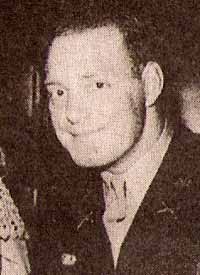
The tragic fate of Lieutenant George E. HENDRICKSON at the Maquis de Broualan
Concerning the care of Lieutenant HENDRICKSON upon his arrival in Brittany, it is impossible in the current state of research to determine where, how and from whom he managed to find assistance. We just know that HENDRICKSON was picked up in the town of La-Boussac (Ille-et-Vilaine) by Jean STEISS on July 6. In the evening, he will dine at Jean LEBOIS’s before heading to the Lopinière farm, located near the Broulan maquis, to spend the night there from July 6th to 7th.
The idea of forming a maquis in Broualan originated in the summer of 1943 when young people resisting the STO were looking for places to hide. Initially, this place was seen more as an area of refuge for those who wanted to escape the Germans and the authorities of the Vichy regime. At this period, it was not only poorly organized, poorly armed and had no strategic or military vocation. In the spring of 1944, the maquis gained in numbers and organization: many Francs-tireurs and partisans (FTP) from the Saint-Malo and Dol region retreated to the Buzot forest, to which were added local resistance fighters. The maquis is structured: regular supplies are put in place, defensive positions are erected, daily military training is imposed on the maquis members. The maquis came under the command of Warrant Officer LAMBERT d’Antrain of the Defense of France (DF) resistance movement and under the departmental responsibility of the FTP commander, Louis PETRI. The latter wishes to make the maquis a place of transit for resistance fighters from Ille-et-Vilaine to other departmental maquis with an offensive vocation such as that of Lignières-la-Doucelle in Mayenne. Like any high concentration of individuals at that time in remote areas, the Broualan maquis did not go unnoticed by the local population and the authorities.
With the Allied landing of June 6, Resistance activity intensified on the territory and vice versa, the operations of attacks and reprisals carried out by the Germans aided by collaborators against the resistance and their bases of withdrawal. Geographically, the Broualan maquis is located in a strategic area due to its proximity to Saint-Malo, Dol-de-Bretagne and its access to Normandy. At the end of June following clashes with the occupier and militiamen, the order was given to around a hundred Broualan resistance fighters to retreat towards the Mayennais resistance. However, the maquis is not deserted and some members of the Resistance maintain their position in the Buzot forest in order to ensure transit between the new arrivals from Ille-et-Vilaine and the maquis established in Mayenne. On July 6, 3 or 4 suspicious individuals were spotted in the commune of Broualan and the maquis was notified but without unduly worrying the maquis command.
On July 7, around 4:00 a.m., around a hundred individuals from the French Militia, the Action Group of the PPF (Popular Party French), from the Perrot Formation (collaborators and Breton nationalists) to which are added police officers from the SD (Sicherheitsdienst: security service of the SS) invest the town of Broualan in search of resistance fighters. There, they took the leader of the maquis, Warrant Officer LAMBERT, prisoner before heading towards the Buzot woods. In the meantime, the residents were subjected to brutal interrogations and 3 people were executed. The alert of a descent of militiamen and Germans was sent to the Buzot woods from where the resistance fighters managed to escape before the attack. But on the farm at a place called La Lopinière, 12 resistance fighters including Lieutenant HENDRICKSON were surprised in their sleep and captured.
The prisoners are transferred by bus to Rennes. Before leaving, the resistance fighters suffered violence and torture from the militiamen who unleashed themselves against adjutant LAMBERT, then stripped and humiliated, as well as another resistance fighter, René CAPITAIN. The latter is then coldly executed with a bullet in the back of the head by a member of the PPF Action Group wishing to try his Colt. His body is left there. It was then that a member of Bezen Perrot discovered the presence of an American among their prisoners. He questions him to find out where he comes from. HENDRICKSON says he is an American officer, that he parachuted into France and was captured, that he is 28 years old and that he is from New York.
On its way back to Rennes, the convoy stops near a quarry located in the town of Saint-Rémy-du-Plain. Seven resistance fighters were designated by the leaders of the collaborationist groups and the SD to get off the bus, including Warrant Officer LAMBERT, who was in very bad shape. These will be shot near the quarry.
As for HENDRICKSON, being in civilian clothes and therefore considered a spy, it seems that the leaders DI CONSTANZO, PERESSE and RIECK of the SD consulted and decided to liquidate him. RIECK then steals his identification tags. Three individuals volunteered to carry it out. After making him walk 200 meters, he was shot in the back. The rest of the resistance prisoners are taken to Rennes for interrogation.
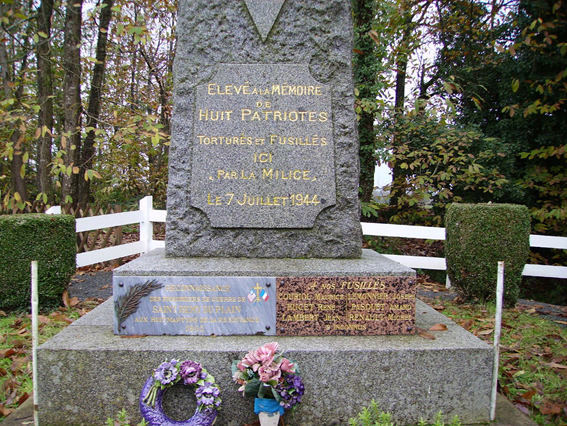
List of 8 Resistance martyrs tortured and shot in Saint-Rémy-du-Plain:
Maurice COURIOL
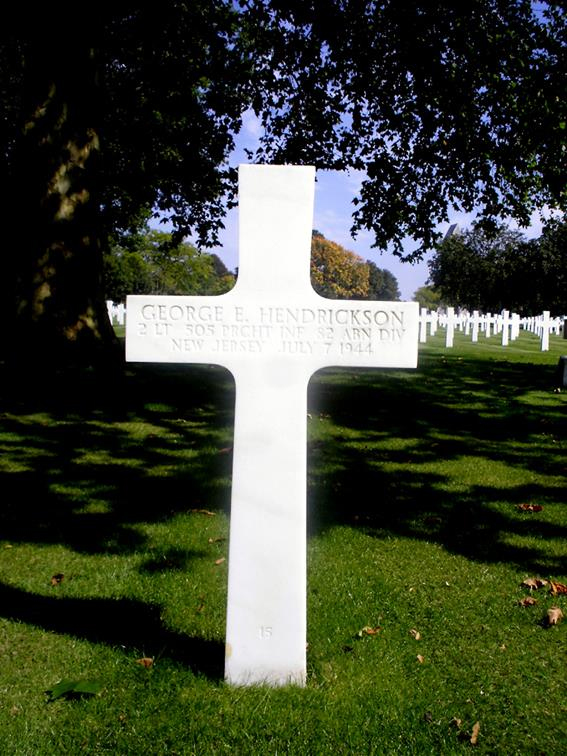
2nd Lieutenant George E. HENDRICKSON
René HUCET
Warrant Officer Jean LAMBERT
Joseph LEMONNIER
Armand PASQUET
Michel RENAUD
Unknown resistance fighter
The remains of eight men were buried in the churchyard at St Remy du Plain in 1945. At that time George Hendrickson was not identified and was listed as (X160) an alleged paratrooper, this was because of two items of American branded underclothing, size 40, marked H7411 found on the body.
His remains were finally and definitely identified as Lieutenant George E Hendrickson on June 7 1948. Mail was then sent to the mother of George E Hendrickson, on June 30 1948. His mother was still living in his native town of Bergenfield, in the State of New Jersey. USA.
His body was then moved and laid to rest in the Brittany American Cemetery, at Montjoie Saint Martin.
Buried: Plot. P Row. 2 Grave. 15
ADDENDUM:
 ONLYVFR
Leave a comment