
Gremlins are well documented throughout aviation circles and in the case of Shoreham Airport I firmly believe they hang out on the riverbank wall at the threshold of runway 25.
The eastern end of Shoreham Airfield is bordered by the river Adur and an earth bank was built to prevent the high tides bursting the bank and spreading over the airfield which was once a flood plain. Between the earth bank and the threshold of runway 25 is the perimeter road called ‘Cecil Pashley Way’ If you put those factors together they all add up to a very quirky approach when windy.
And that is why the gremlins have built their Lair under the river bank, looking out for any airman that is on approach and flirting with the stall.
On the 16th September 2000 I took Tiger Moth G-AMNN to Biggin Hill, this Tiger is aptly named ‘The Spirit of Pashley’ and it was at that time the flagship for Northbrook College. The Tiger was to go on the static line at ‘The battle of Britain Airshow’ and would be there to promote the aeronautical and automobile courses run by Northbrook college based at Shoreham.
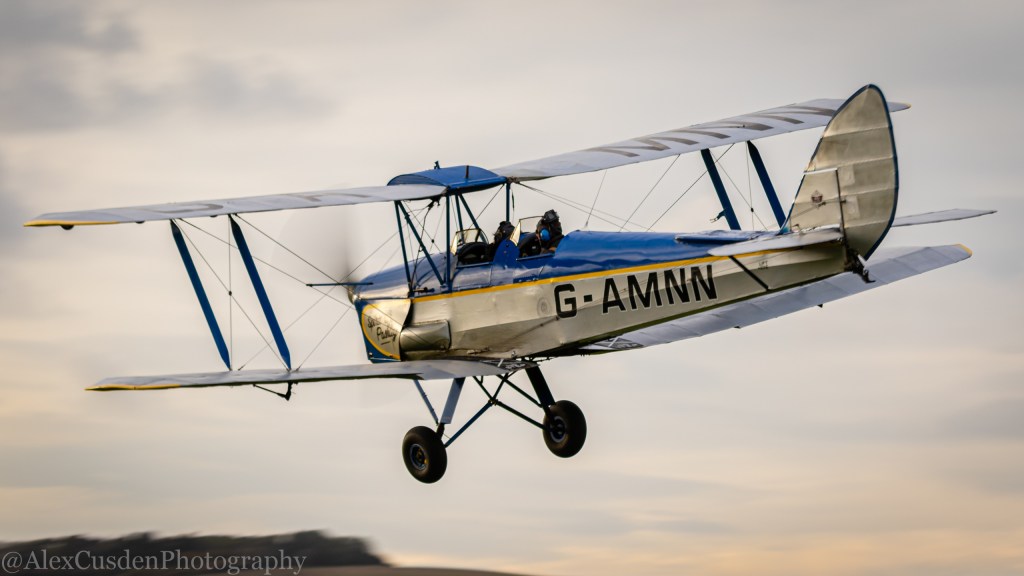
It was a fine day for an Airshow and on board with me was a student from the college who would be promoting those courses, his reward for doing this was the trip in the Tiger, whilst another student drove up to Biggin with the table and stall they used. The student who flew up would do the drive back whilst the one that drove up would get the flight back.
This gave all concerned a benefit. The students would get to fly in the Tiger. I would get to fly the Tiger and the College would get the chance to further their cause.
The interest from the public was always high. Imagine this, parents take their children to airshows and the children get an interest in aviation. For them to find a stall that offers training into a career within aviation, well it’s a no brainer.
A positive for me that day, was that I met an ex Luftwaffe BF109 pilot, Urlich Steinhilper. It was fascinating to talk to him and he was, in turn, fascinated by the Tiger knowing that his adversaries back in 1940 had been trained in one very much like it. Urlich was shot down on 27 October 1940 over Canterbury, possibly by RAF ace, Squadron Leader Archie Mckellar or by Sergeant Bill Skinner of 74 Squadron. He was then made a prisoner of war after parachuting to safety.
In January 1941, he was sent across the Atlantic Ocean to Canada to be interned. He made his first escape there on 23 November, remaining at large for two days before being recaptured at Niagara Falls. He went on to make numerous escape attempts and knew Von Werra (the one that got away) his book ‘A spitfire on my tail’ is most entertaining.

Our start up time at the end of the show was 1800 hours, having called up ATC they cleared me to taxi off the static line and continue up Taxiway Charlie. I had to remind them that November November was a Tiger moth and had no brakes and only a tail skid at the back, I requested to cross onto the grass to the west of the paved runway 21/03 and taxi on the grass where I could depart from the side of runway 21. The clearance was given and we continued up to midpoint. My engine runs had already been done so I requested an immediate departure on reaching the centre of the field, but was told the Lancaster had a slot at Scampton and would depart first. That will be good (I thought) as I was in an ideal position to watch the old girl trundle by. However, I bet the gremlins based at Biggin were already beginning to snigger as they could see my position in relation to the Lancaster. I was about to learn a lesson regarding wake vortex turbulence.
An aircraft of a lower wake vortex category must not be allowed to take off less than two minutes behind an aircraft of a higher wake vortex category. Especially if the following aircraft does not start its take off roll from the same point as the preceding aircraft, this is increased to three minutes. To put this more generally, an aircraft is usually safer if it is airborne before the rotation point of the airplane that took off before it. However, care must be taken to stay upwind (or otherwise away) from any vortices that were generated by the previous aircraft particularly in our situation with an active crosswind.
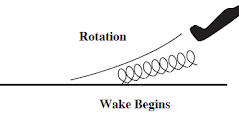
In our case we were at midfield and the Lancaster would be considered heavy compared with my Tiger. The Lancaster rotated about 100 metres in front of us and we were then cleared to depart. I started the take off run knowing that I had a crosswind from my left, but not considering that the crosswind was drifting the Lancs vortex across my path. I got airborne and immediately went into a knife edge, the left wing came very close to the ground. Instinctively I pushed the stick forward and to the right and added a healthy bit of right rudder. The take off must have looked quite spectacular and may have even impressed some who might have thought me a hot shot pilot doing a maneuver like that after take off. Not the case at all, I personally blame those damn Biggin Hill gremlins, they came out from their hiding place and immediately grabbed my wing. They tried to drag me back onto the ground and they would have been absolutely delighted had I come to grief due to me not taking into account the Lancasters’ wingtip vortex and the crosswind.
Sheepishly I continued to climb away and depart Biggin for Shoreham, routing via Paddock Wood in Kent and Crowborough avoiding the Gatwick zone.
But those gremlins had not finished with me yet, they had probably already phoned their relations that live on the bank of the river Adur, at the eastern end of Shoreham Airport.
I turned right from a southerly heading at Crowborough onto a west south west heading, in doing so I slipped under the south east edge of the Gatwick zone by remaining under 1500 ft. I had a visual with Haywards Heath so I knew all was well. A few minutes into that heading I noticed quite a decrease in my groundspeed, so I noted my position on the map (no GPS) I then took a five minute timing and noted my position on the map again, my indicated airspeed was 70 knots and I had travelled only 4 nautical miles, which means I had become subject to around 20 knots on the nose. No problem at that point, but it meant it would likely be that strong and maybe more at Shoreham. I tuned the radio to the Shoreham ATIS and sure enough they were giving 250 degrees 18knots, occasional gusting 28. Well that wasn’t in the forecast.
I had a chat with the passenger and said it might get a bit bumpy when we start descending on approach. I also ran through with him that when we came to a halt on the runway I would like him to climb out and go and hold onto a wing tip as I would need him to help steer the Tiger as we taxied off the runway and returned to the Northbrook hangar.
I called Shoreham Air traffic giving them an ETA and asked for a wind reading, which came back as 20 with a 25 knot gust in the last 5 minutes. Ok, I think that will be manageable, but I knew that over the river it would have a mixture of rising and sinking air. The riverbank would produce an updraft of air, but first we would experience sinking air over the river itself. The gremlins were rubbing their hands already.
About five miles out I called for a straight in approach, this was cleared and we started the descent. About half a mile out I asked for another wind reading and was given 250 20/25.
We came over the river and the expected sink came in and I responded with a bit of power, a second later the Tiger was caught in the updraft and the power came off before upsetting my trim. I swear I saw those mischievous gremlins jumping up at me and trying to prematurely pull the Tiger onto the ground. However as we came over the perimeter road and passed the threshold all the turbulence turned into a steady wind straight down the runway, we touched down and almost immediately came to a stop. The lad in front was out like a jack rabbit, he jumped off the rear of the wing and went directly to the left wing tip, holding the leading edge which allowed me to turn left and get the rudder to move against the wind that was still blowing at 20/25 knots.
I took a quick look back toward the river bank and I could see the disappointment in those ugly little beasts as they lined up on the tow path at the top of the bank. I gave them a swift Churchill wave and continued to taxi in.
The mischievous creatures that I have mentioned throughout this piece are well known as mythological entities that have the reputation to harass an aircraft, cause havoc aboard and become the ultimate blame after an aircraft is brought down from the skies. They are ‘the Gremlins’
Postscript….
The Gremlins:
The gremlins are waiting just over the wall.
They’re waiting and watching to give you a fall.
When least you expect it they are out in a flash.
To trap the unwary and laugh at his crash.
When coming in slow with a few feet to spare.
The gremlins will spot you and creep from their lair.
They’ll shoot out their arms with lashings of mirth.
Then seize your contraption and drag it to earth.
Beware of the gremlins that live by the wall.
They’re waiting for fellows that flirt with the stall.
Remember my warning and give her the gun.
Or else you will arrive as some others have done.
The above three verses have been taken from an anonymous poem, it is believed to have been written in 1938 at Halfar, Malta and thought to have been penned by a fleet air arm pilot. The full poem can be found in a book edited by Laddie Lucas, called ‘Wings of War’
 ONLYVFR
Leave a comment