
This rather harrowing story happened in the 1970’s. Those that know me will be aware that I have a phobia about flying over water in a single engine aeroplane. It is equivalent to telling ghost stories by candlelight. It sends a shiver up my spine.
………………~~………………
On the 12th October 1974.. A Cessna Cardinal 177RG, registration G-BBHH, departed Redhill going direct to Lympne on the Kent coast to pick up fuel and clear customs. It was then to fly onwards to France, (destination unknown). The fuel bowser at Lympne was reportedly almost empty. The Cessna Cardinal departed again after uplifting some of that fuel.
A few miles out to sea, South East of Lympne, the aircraft suffered an engine failure and ultimately had to ditch in the English Channel. The pilot ‘Jim Pearce’ was picked up by a Dutch merchant ship ‘Sylvia 1’ at 2.45 pm local time. The Captain of the Sylvia (H. C. Vos) put Jim ashore in Dover at approximately 5.00 pm. This is Jim’s account of that day as related by him over the years to myself and Jim’s son, Colin.
The Cessna 177RG Cardinal is a light single-engined, high-wing aircraft with retractable undercarriage, which is a good thing, as we will find out within this account of Jim having a very bad day.
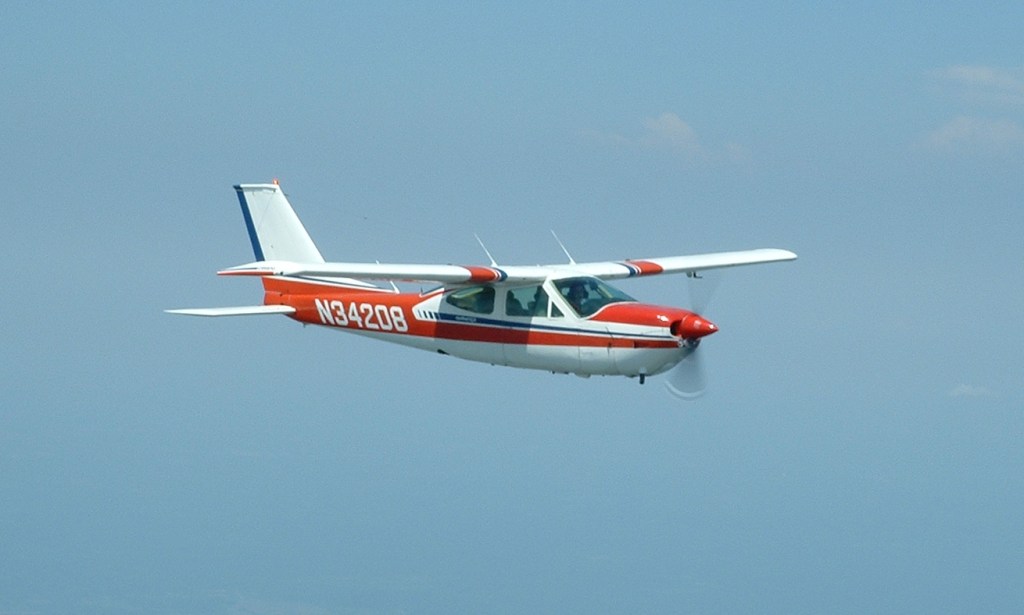
Jim had departed from Lympne at approximately 14.00 hours or 2pm local. We do not know his ultimate destination, but a direct route South east from the old Airport of Lympne across the Channel will take you to Le Touquet and also in 1974 Le Touquet had full French customs.
Jims problem began about 9 miles out from the English coast, the engine started to miss and stutter, then it stopped, his first instinct was to turn back towards the coast, but it very quickly became obvious to him that the coast was not achievable.
He then saw a merchant ship which was travelling in a westerly direction having just come through the Dover Straights. He decided this was going to be his objective and even considered landing on the deck of the freighter, he then established the aircraft into a stable glide angle, however as he got closer to the ship he rejected the idea of putting it down on the deck. He now decided that he would fly the aircraft across the bow of the ship, this was for two reasons. One being that he wanted to make sure the crew on the Sylvia would see him and it also offered him the chance to ditch on the leeward side of the ship because the water would be calmer. He started putting his flaps down and crossed the bow of the Sylvia just as he had planned, then he turned the cardinal to put it down onto the water.
His comments on this part of the ditching was that the Cardinals first contact with the water was smooth and it started to ski across the surface until it encountered a wave, the aircraft’s nose hit the wave which brought the aircraft to an abrupt stop. The nose immediately went under the water and the tail came up to the vertical. It made no attempt to float and immediately the cockpit section became submerged which meant that he could not get the door open as the water pressure outside was greater than the air pressure inside the cockpit. He unstrapped and shuffled across the seats to reposition himself and started kicking the clear Perspex panel on one of the doors. Water was coming in through a number of orifices but until the cabin filled up and the pressure equalised the doors were not going to open.
Meanwhile the aircraft continued to sink and Jim told us that as it did so things started to get dark, very dark and very quick. Finally the Perspex gave way and the water poured in and filled the cabin up with very cold channel water, as it did so he took a deep breath from the remaining air and held onto it.. Now the doors would open and he started to evacuate. This then revealed his second problem, having exited the cabin he inflated his life jacket, but it had become twisted around his neck whilst he had been kicking the door and as it inflated it had become entangled in the Cessna style barn door flaps of the aircraft. He obviously knew he had to get clear as the plane was now rapidly sinking and was still in a pitch down attitude. He started to claw and grapple with the flaps, knowing he had to find the trailing edge to get himself clear.
Eventually he succeeded in escaping the entrapment of the flaps and after that effort his life jacket now took over and started to shoot him up towards the surface. However due to the pronounced angle of the aircraft which was now descending even more rapidly into Davy Jones’s locker he remembered hitting his head on the tail plane as the life jackets buoyancy helped him to make his way up to the surface.
With great relief and bursting lungs Jim finally made it to the surface. Gathering his thoughts together after such exertion, he started to look around. His comment at this point was that although he was bobbing about on the surface between the waves, he never seemed to make it to the top of the waves to be able to get a clear look around. One thing he was sure of was that he couldn’t see the ship, the ship had gone, but he could see a small aircraft circling overhead. Also items from within the sinking aircraft were now floating to the surface around him, one of them being his map. His sense of humour allowed him to consider, (in that dark moment) that if the ship did not return at least he could now map read his way back.
The temperature in the English Channel is on average 10 degrees. This will give approximately 20 minutes before hypothermia sets in. Jim had ditched around 2.30pm, without immediate assistance his chances were still extremely slim.
Jim’s luck had in fact held, there had been a crew member on the deck, however it had still been a matter of chance that he had lifted his head to see Jim cross in front of the bow. Thankfully the rest of the crew had then been alerted to the aircraft ditching into the water. They had taken immediate action to stop the ship and pick him up. However a ship of this size will take about one, maybe two miles to turn around.
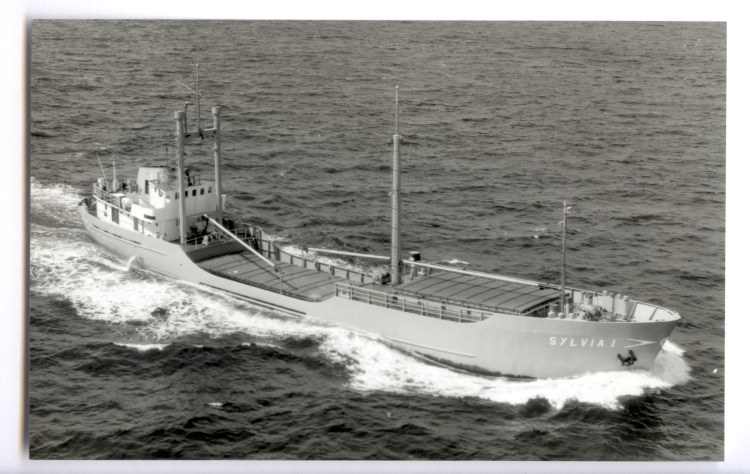
At 2.45 the ship returned and came along side to pick Jim up out of the water. The light aircraft that had remained circling above Jim had enabled the Sylvia’s Captain to return to the exact spot. They threw him a lifebelt ring which was attached to a rope but Jim had no feeling in his arms now because the sea had taken his core temperature down. This had taken him to the point where he said he had a real calm feeling come over him and he was drifting comfortably off to sleep.
The crew realised he was unable to hold onto the belt so two of them got into the water and assisted him back to amidships where the deck was closest to the water’s surface and he was pulled onto the deck.
They immediately got him down to the boiler room, stripped his wet clothing off and started to pummel his body to get the circulation going again.
The coastguard helicopter had been alerted (by the light aircraft) to the crisis and had positioned itself over the Sylvia in order to winch Jim aboard, however Captain Voss refused to have him winched up as in his opinion Jim had done enough flying for one day. He told them that his intentions were to turn around and take him back to Dover harbour. Folkestone harbour had, at first, been considered but Folkestone could not accommodate his ship.
In the warmth of the engine room Jim had recovered quite quickly and had struck up a rappour with Captain Voss. At 5pm Jim was handed over to the port authorities in Dover and the Sylvia went back to sea and on its way (according to ships papers) to the far east.
It is at this point that Colin’s account and mine differ a little bit.
A few months later Jim met Captain Voss and his crew in Holland and a party was arranged to celebrate saving the life of the downed flyer. My account of this part of the story is that at the party Jim had told Captain Voss of his original intention of putting the Cardinal down on the ship’s deck, this had caused an alarmed look on Voss’s face.
The conversation that followed unveiled the fact that Syvia 1, was actually on route to the then apartheid country of South Africa and that because of the international blockade during that decade his Dutch paperwork had shown his destination as the Far east. His cargo had being explosives for the diamond mining industry, but what shocked Captain Voss most of all was the fact that the boxes on the deck of Sylvia contained detonators.
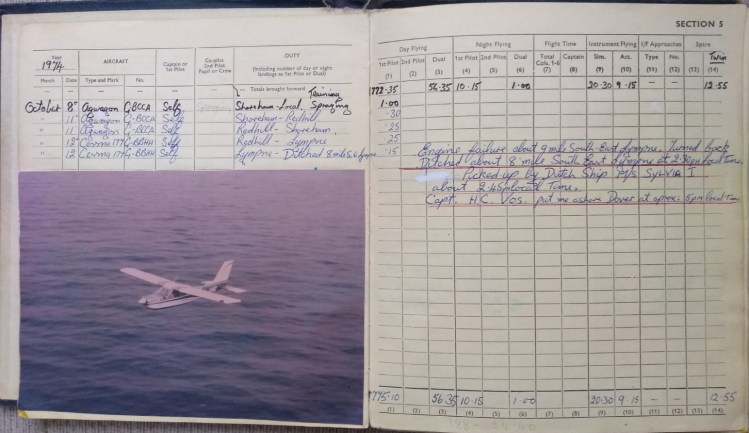
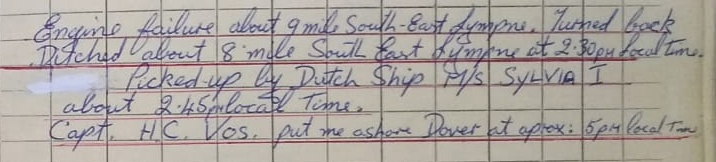
Jim often pondered over his engine failure and the power off descent that day into the cold water of the English Channel.
1:..He had no recollection of whether he carried out an engine failure procedure. Not that it really mattered.
2:..He always advised anyone (after this event) to unlatch the cabin doors and the windows in the descent, also (if possible) to wedge a shoe or something to hold a door slightly ajar.
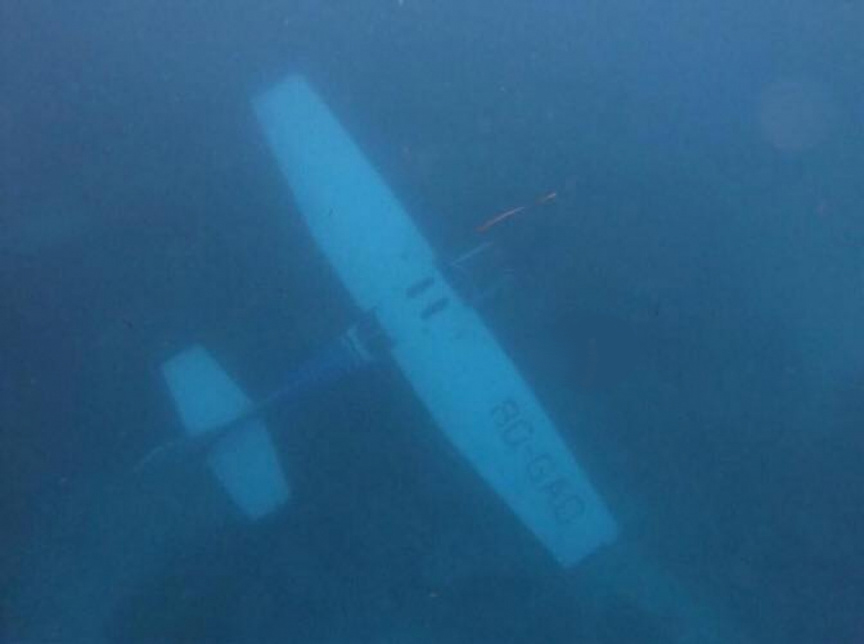
3:..Most of all he always maintained that putting full flaps down on a high wing Cessna for ditching was a bad idea, as it caused him such distress that day in getting untangled from them and hindering his get away from the rapidly sinking aircraft that is still, to this day, resting at the bottom of Davy Jones Locker.
……………………………~~………………………………
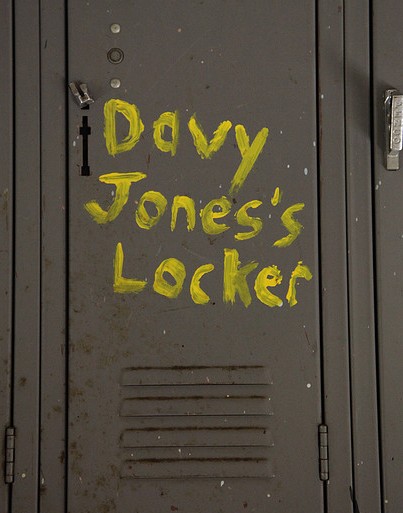
Davy Jones locker refers to the bottom of the sea, it is especially regarded as the grave of those drowned at sea. Of course Jim survived and lived on for many years. He passed away on 26 July 2017 at the age of 87.
The origin of the phrase ‘Davy Jones‘ locker‘
Davy Jones was a 16th century publican who imprisoned drunken sailors in a locker and press-ganged them to serve on ships. The name also comes from the patron saint of sailors – St. David.


 ONLYVFR
Leave a comment