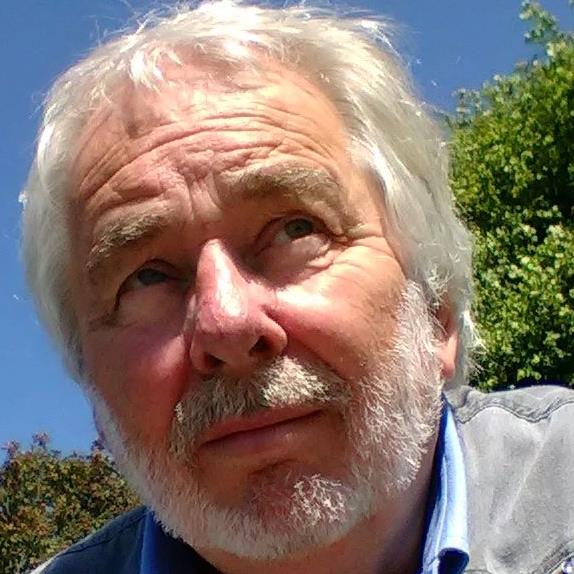
I first met Jim Pearce through another flying friend of mine, John Flavell. John and I were having some lunch in the Terminal restaurant at Shoreham Airport in Sussex (which was run in those days by Ken Ferrenbach) when this jolly chap with a slightly rotund figure walked across to greet John, from the first moment it was quite clear that there was a very mischievous character about Jim.
Jim often just wore a shirt and jeans and the Jeans were almost always supported by a cowboy belt. When you encounter someone as unassuming as Jim, his ability as a pilot can pass you by at first and go unnoticed. This was Jim Pearce, he was not your visual idea of a “top gun” pilot. He was hardly a Tom Cruise, although he may very well have been in his younger days. It was only when you flew with him that you realised this man had enormous talent when it came to hands on flying.
Obviously Jim and John knew each other well, for the first few minutes I sat there truly out of the conversation, it could almost be said that I was not really there at that point. However it came round to Jim offering John a ride in his plane down to the Isle of Wight and help him do a small job for a farmer on the Island. John said that he had to go back to his office and was committed, it was at that point John pointed at me and said, “This is Bev and I am sure he will go and help you” I honestly think Jim had not noticed me sitting at the table till that point, he looked across at me and appeared to be quite unimpressed.
Jim said “Ok but I will need to get a cushion out of the office” Jim was the Pilot and owner of the Sussex Ag Company, he had an office on the first floor of the eastern end of the terminal. I followed him up to his office after leaving John to go back to his commitments. We got a couple of cushions and we proceeded to walk out to the airport apron where his aircraft was parked, but we appeared to be walking towards a strange looking aircraft with a very long nose. It was a Piper Brave, a crop sprayer and it only had one seat.
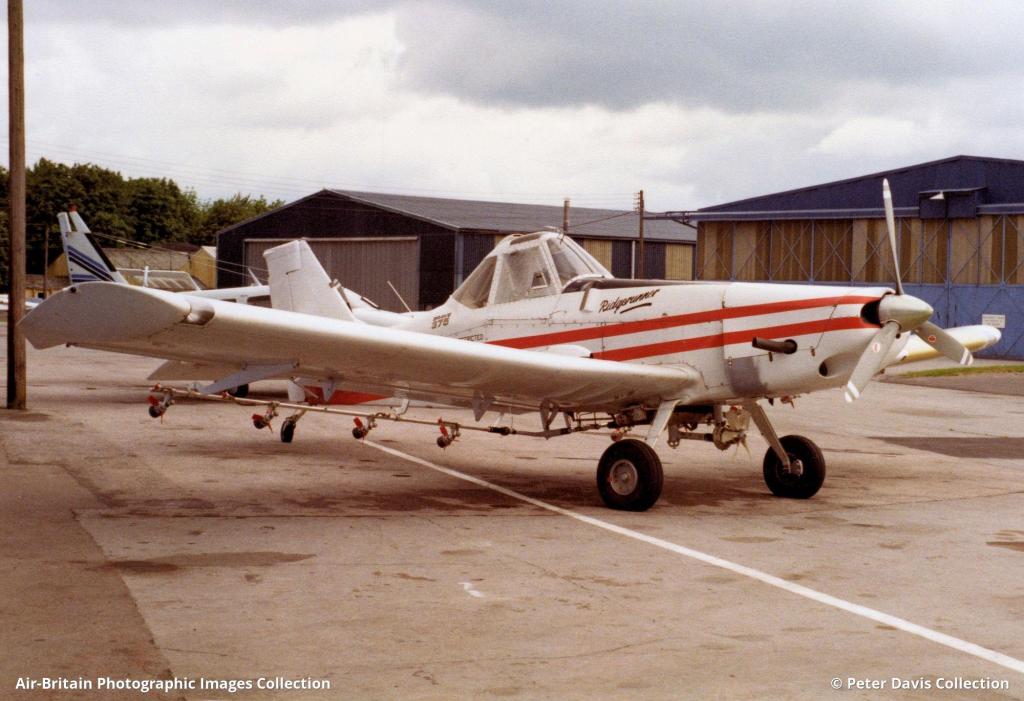
The Brave proudly displayed the name “Ridgerunner” just forward of the cockpit. Jim climbed onto the right hand wing opened the side door which folded down and he started to tuck the cushions down the side of the single seat. “Here you are” he said and I climbed in placing myself snuggly to the right of the one seat within the cockpit, I had to slightly lean to the left and put left arm around the back of that only seat in the house.
On the way out to the runway Jim (who was getting used to me now) informed me he had a fear of heights and also had a phobia about water, well that was encouraging. He then continued to tell me that after take off we were going to go straight to the coast and we would follow the coastline, slightly out to sea and go down towards Selsey Bill at about 50 feet. Which seemed to indicate he did indeed have a fear of heights. but his phobia about water was less strong.
We flew offshore down to the Pagham bird sanctuary, which is west of Bognor Regis, we then flew overland till we reached West Wittering. At West Wittering he headed out over the water again towards the two forts that are situated in the eastern approach to the Solent, we were still at 50 feet and we actually passed below the level of the forts. The first fort being “Horse Sand Fort” and the second being “No Mans Land Fort”
Crossing the Island coastline east of Ryde we kept low but avoided any towns and only flying over open ground, heading south to Arreton Down where we then followed the line of hills that stretch across the Island from east to west.
I have now finally come to the point of this little story, Jim started pointing out things on the ground, one being a farm where the farmers wife apparently made purple cakes, (he did have a sweet tooth our Jim). Then he told me if I looked to the right I would see one of the places that he used for landing and operating out of. I looked down, but could not see a field that would be considered suitable in length to use as a landing strip.
“I’ll show you” he said, “If the gates open”, his mastery of hands on flying was now going to be shown to me. We started a slow curving descent and I could now see that there were two fields divided by a hedge and a five bar gate, above the hedge was a power line, in order to get into the field the aircraft had to go under the wire but could only get the aircraft through if the gate was open.
Jim’s approach to this field landing was so smooth, no fiddling with the stick, it was one smooth controlled movement and we went under the power line and the undercarriage went through the gap left by the open gate, we touched down and the power went back on and we flew away. I was hooked and now I knew that I had to take up any chance of flying with this man as it was always going to be an experience.
I have never seen anyone quite as one with a machine. His situational awareness was second to none. I have seen him go through gaps in trees that are less than the wing span, by skidding the aircraft.
He could spin his wheels on the top of a crop, go through gaps which were less than his wingspan and easily follow the undulations of the ground beneath him.
I was going to learn a little about crop spraying over the years whilst I helped him and Colin (his son) on ground duties. Different farmers have different views on the density of chemicals they want on their land and this is not just controlled by working a release gate in the cockpit that regulates the amount that leaves the hopper, but also the speed of the aircraft across the ground and the height above the crop changes those factors.
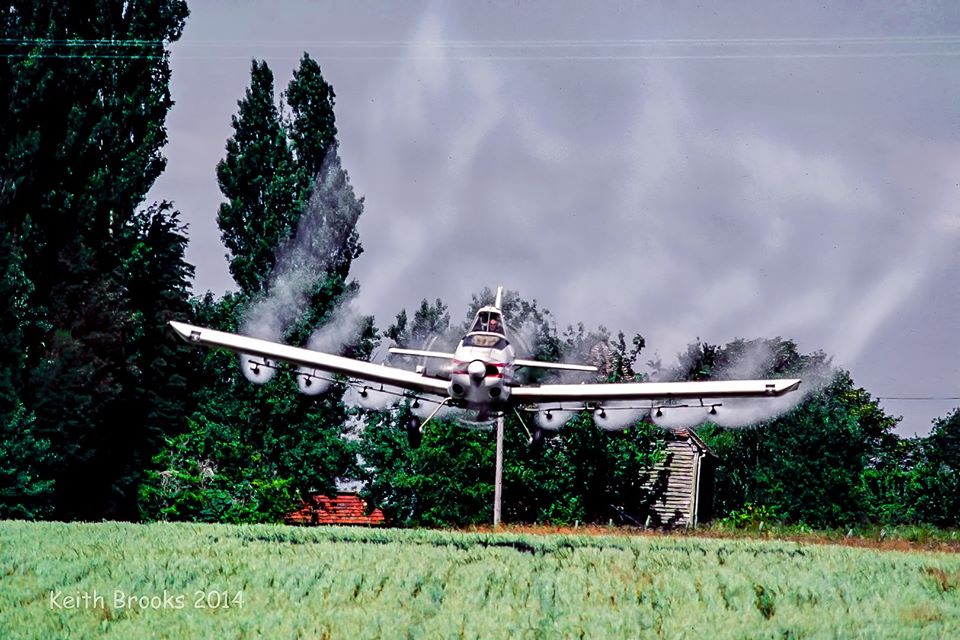
(Jim Pearce)
CAN YOU SEE THE WIRE IN THIS PICTURE.
The speed of the aircraft over the crop also has to be controlled with the consideration of energy being left in the aircraft on the pull up at the end of the run. Jim had all this in his head, constantly working in the wind factor and getting maximum time over the crop and minimum time in the turn when he would be off the crop.
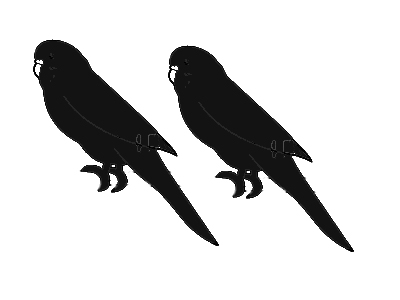
Jim often faced complaints from people claiming to be affected by aerial spraying. It has to be said that it went with the job. One particular case was a lady who complained he had killed two of her Budgies spraying chemicals over the farmland at the bottom of her garden. He had to write a report over the matter. Using local weather reports for the day of the complaint, he showed that the wind was blowing from the house and could not have drifted onto her property. He also obtained scientific advice that the budgies could have eaten their own weight of the chemical and not be affected, he heard no more.
The incident however inspired me and Colin to put two silhouettes of budgies under his canopy and they stayed there for some considerable time.
We were always playing pranks on each other. One particular favourite that Colin and I would pull is that after a mornings flying, when Jim had eaten his lunch and drunk his tea, (which was always made with Fussells condensed milk) Jim would like to have a nap. Whilst he was slumbering we would collect leaves and small twigs. We would then drop them in his lap shouting “PULL UP” The effect was always very amusing and I am sure it helped keep him on his toes.
Jim’s love of flying and and interest in historical aviation, as great as it was did not stop him from staying in touch with his roots in agriculture, he was an expert ploughman and in the summer would win many medals and trophies at ploughing competitions throughout Sussex and Kent.
His interest in historical aviation would see him later in life as a renowned and successful warbird recovery specialist. His contacts through his international crop spraying days were used to obtain a number of WW2 aircraft from behind the eastern bloc countries, mainly in Russia.
……………………………………………………………………………………………………………
Jim Pearce’s Obituary written by: MICK OAKEY/THE AVIATION HISTORIAN
The most successful warbird recovery specialist of the past 25 years, West Sussex-based Jim Pearce, died on 26 July at the age of 87. Born on a farm in Surrey on 21 October 1929, Jim began his working life there, but dreamed of becoming a pilot from a young age. He served with the RAF in Aden, and was to combine his love of flying and his roots in agriculture in the 1970s when he formed a crop-spraying business, going on to clock up thousands of hours dusting all over the world.
Jim rebuilt several 1950s Percival EP9 Prospectors at Lympne during the late 1970s. A little over a decade later, after the fall of the Soviet Union he was able to access many crash sites in the former Eastern Bloc through some of the contacts he had made through crop-dusting. Jim and his team went on to recover more than 50 aircraft, many of which are either now flying or on show in museums around the world.
One of the first recoveries involved the substantial remains of a Focke-Wulf Fw 189 — a previously extinct type — which had forcelanded at Louhki near Murmansk in May 1943. It arrived at Jim’s farm close to Findon in Sussex in February 1992, along with a Messerschmitt Bf 110E-2 found 40 miles west of Murmansk. This was followed by several examples of the Hawker Hurricane, Messerschmitt Bf 109, Curtiss P-40, Ilyushin Il-2, the remains of a Focke-Wulf Fw 190F-8, another Bf 110, and totally intact lake-recovery examples of the Bell P-39 Airacobra and Bf 109E-7. The Bf 109, Werknummer 3523, was originally built as an E-1 and is a Battle of France and Battle of Britain survivor. While being flown on the Eastern Front by 36-victory ace Wulf-Dietrich Widowitz on 4 April 1942, it belly-landed on a frozen lake near Pestamo, eastern Finland, sinking through the ice and remaining on the lakebed until being recovered by Jim in 2003 (see ‘Emil and the Detectives’, Aeroplane October 2004). It is now with Comanche Fighters in Houston, Texas, and will be preserved in original condition.
Jim Pearce also operated a Pilatus P2 and, latterly, a Miles Messenger from his strip in Sussex. On 10 August, at the close of Jim’s funeral at St Mary’s Church, Shipley, warbird pilot John Dodd gave a display in Martin Phillips’ Spitfire IX RR232/G-BRSF, another former Jim Pearce aeroplane, which he sold for restoration to fly during 2001. It took to the air again at Filton in December 2012.

Jim Pearce (left) with Lothar Mothes, the wartime pilot of Focke-Wulf Fw 189A-1 Werknummer 2100/V7+1H, sitting in the aeroplane at Biggin Hill on 15 September 1996. The last time Lothar had seen it he had been crawling away after being shot down in it in May 1943. MICK OAKEY/THE AVIATION HISTORIAN


 ONLYVFR
Leave a comment